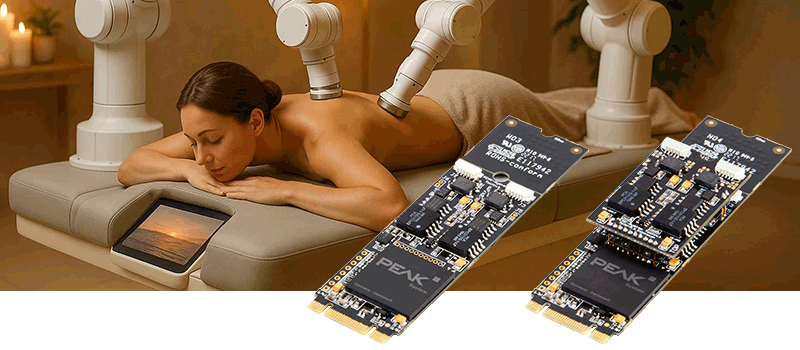
Fully automated massage robot control
ADLINK (plateforme IPC MVP-5100)
Real-time, safe CAN communication in contact with humans
PCAN-M.2 (mono-canal)
The problem
For the complex control of massage tables equipped with robotic arms, Taiwanese IPC manufacturer ADLINK needed a robust and easy-to-integrate CAN communication interface. The system includes three industrial PCs built into the table, one of which is dedicated exclusively to the precise control of the robotic arms and sensors.
Implementing a fully automated massage robot imposes strong constraints: communication between the multiple axes and the infrared sensors must be coordinated in real time for smooth, precise movements. The control system must be robust and fail-safe, since the robot operates in direct physical contact with humans, in professional and public environments. The systems also had to meet strict US market standards (UL and FCC classifications) and remain Linux-compatible for smooth software integration and long-term maintainability.
The solution
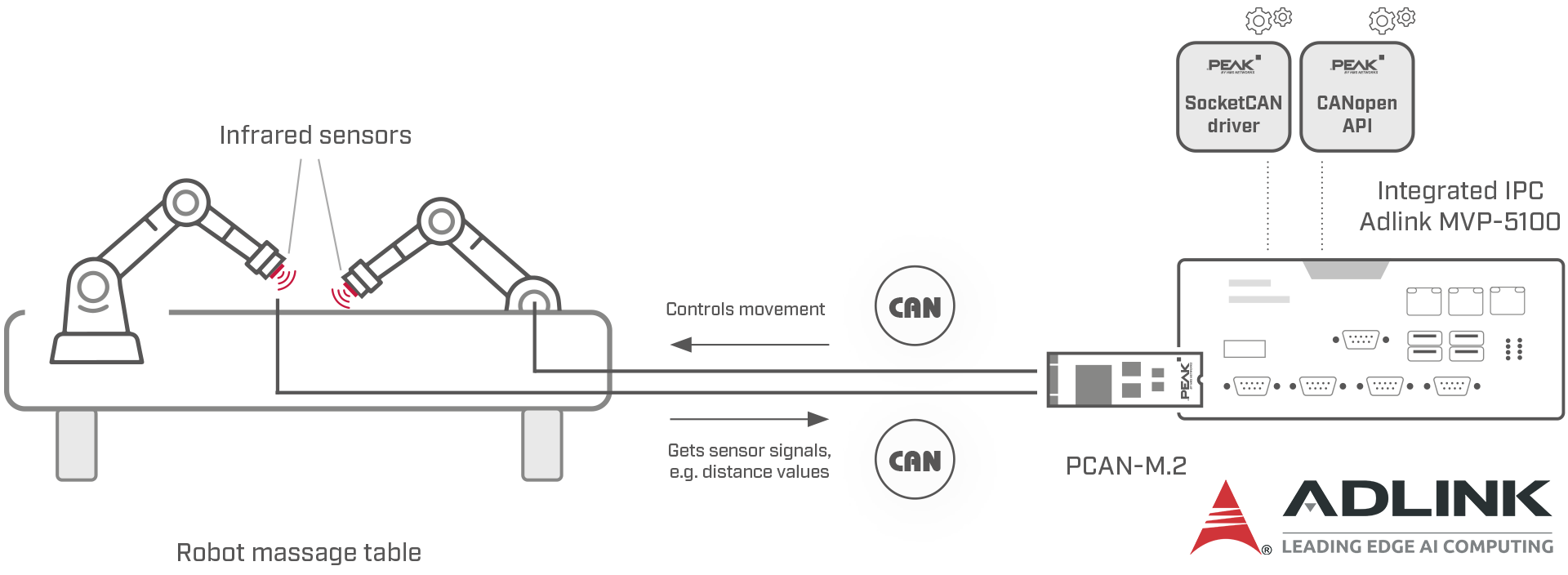
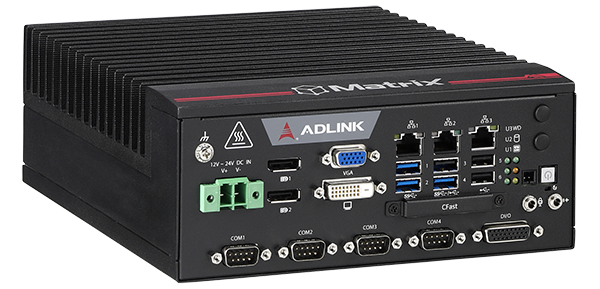
The architecture relies on three ADLINK MVP-5100 industrial PCs, one per table. One of them houses the CAN interface and controls the robotic arms as well as the infrared and position sensors; a second, equipped with a GPU, handles image processing and motion analysis; the third provides general control and diagnostic functions.
1. L'interface PCAN-M.2
For this sensitive CAN communication, ADLINK selected the single-channel PCAN-M.2 interface. A compact plug-in card (80 × 22 × 46 mm), installed directly in the IPC housing via the M.2 slot, it supports CAN FD for high bit rates and stable transmission.
2. Real-time performance thanks to DMA
A decisive advantage: support for DMA (Direct Memory Access). Data is transferred directly between the hardware and main memory without involving the CPU, reducing latency and improving overall performance. Combined with the PCAN-M.2's PCIe interface, DMA guarantees stable throughput even in demanding real-time applications.
3. SocketCAN driver and CANopen API
On the software side, the system relies on the SocketCAN driver, already built into the standard Linux kernel, without any additional proprietary software. ADLINK also uses a community CANopen API to communicate with drives and sensors: addressing arm actuators, reading states, controlling motion profiles.
"By combining the SocketCAN driver with the CANopen API, you get an open, extensible system that can adapt to future needs, while ensuring stable, deterministic, low-latency communication — crucial for the robot's real-time motion control."
The result
Thanks to the PCAN-M.2, ADLINK has deployed a reliable and future-proof communication solution, fully integrated into the MVP-5100 platform. Native Linux support, CAN FD compatibility, and enabled bus termination greatly reduced integration effort. Combined with ADLINK's fanless industrial PCs, the setup delivers maximum stability, minimal maintenance, and long-term availability.