The SENT protocol (SAE J2716): basics, application, and practical use
SENT (Single Edge Nibble Transmission), specified by the SAE J2716 standard, is a cost-effective, robust, and widely used sensor data interface. Designed to transmit sensor data quickly and without interference directly to control units (ECUs), it is unidirectional: data flows exclusively from the sensor to the ECU.
SENT is particularly suitable where classic analog signals or PWM outputs no longer suffice in terms of accuracy, EMC robustness, or diagnostic capability, while buses such as LIN or CAN would be too complex and costly.
Typical use cases
SENT is used in modern vehicles wherever high-resolution sensor data is required: pressure or temperature sensors for interior climate control, engine compartment temperature sensors, or mass air flow sensors. Particularly reliable in environments with strong electromagnetic interference, it is common in powertrain technology.
SENT in detail: physical principles
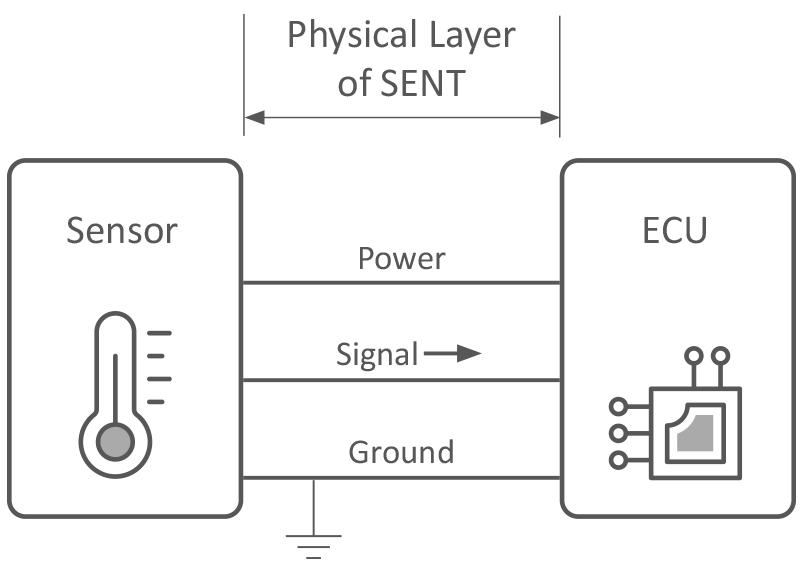
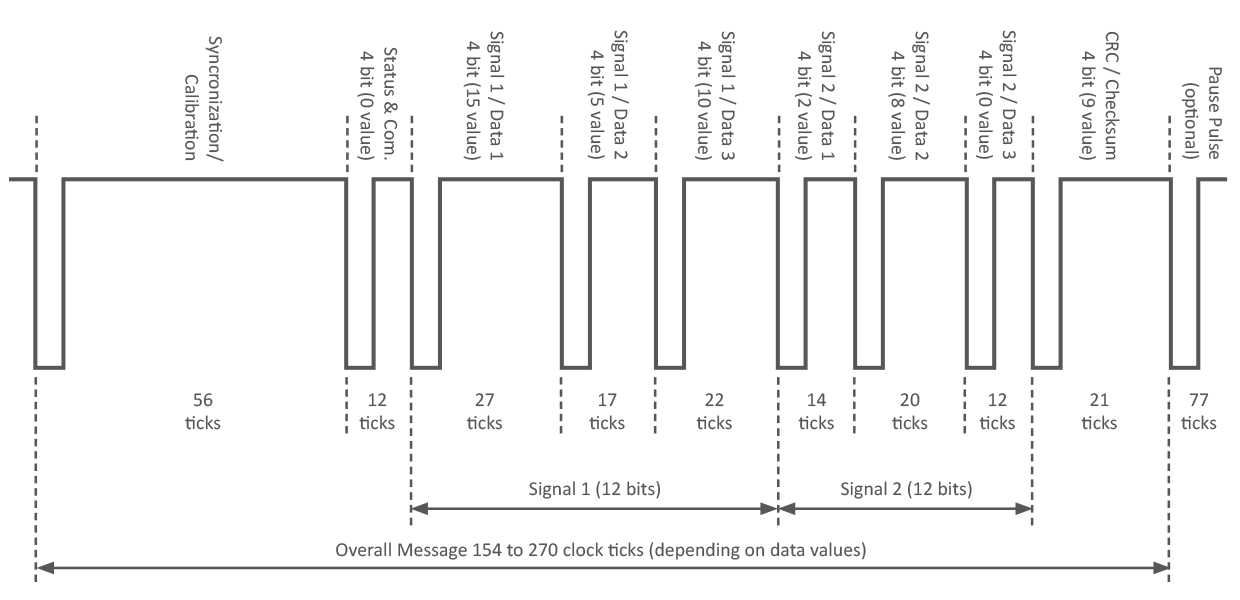
Technically, SENT is based on a three-wire interface: signal line, sensor supply voltage, and ground. Signaling is not done using data packets in the classic sense, but by measuring the time intervals between falling edges (PWM). The time base, called a tick, ranges from 3 to 90 microseconds and is defined by the transmitter. For the receiver to accurately determine the actual tick duration, each frame begins with a synchronization and calibration period of 56 ticks. A symbol, or nibble, always comprises a fixed low phase of about five ticks and a variable high phase; the nibble value is calculated by subtracting twelve from the total number of ticks between two edges.
A typical fast channel frame consists of eight nibbles, i.e. 32 bits: a status nibble, two twelve-bit measurement channels, and a CRC nibble for error detection. An optional pause can be inserted at the end of the frame to maintain a constant total duration. In addition to the fast channel (measurement data), a slow channel provides supplementary information — diagnostic or calibration values — via the status bits, transmitted fragmented across several frames.

Bit rate and performance
The SENT bit rate is not fixed: it depends on the chosen tick duration and pauses. With a 3 µs tick and an average nibble of about 20 ticks, frame duration is around 0.65 ms, giving a frame rate of about 1.5 kHz and a net data rate of about 37 kbit/s for 24 bits of payload. SENT thus offers much higher resolution than analog signals, but remains far from the bit rates of CAN FD or Automotive Ethernet.
Its advantages: extremely low hardware complexity (a single signal line), robust time-based encoding against interference, deterministic transmission, and typical resolutions of twelve bits per measurement channel without the cost of a full bus interface. The integration of diagnostic data via the slow channel further enhances its usefulness. On the other hand: a purely outbound protocol with no return path (parameterization and requests require additional interfaces), strictly point-to-point communication with no bus structure, and limited bit rate compared to modern buses. Modern oscilloscopes and PC decoders simplify analysis (automatic tick calibration, nibble decoding, CRC checking). The "SENT-B" revision currently under development will roughly double the speed.
Implementing SENT with the Ixxat Mobilizer
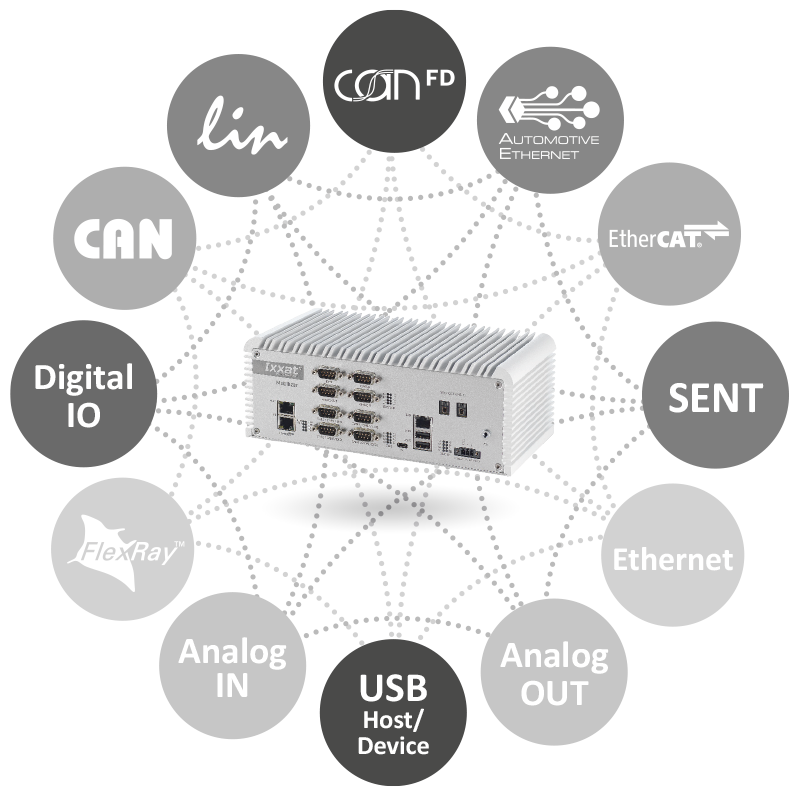
HMS Networks supports SENT sensors via its Ixxat Mobilizer range of automotive gateways. With its diverse range of onboard network interfaces and built-in simulation and automation capabilities, this range combines vehicle data (CAN FD, LIN, K-Line, Automotive Ethernet, FlexRay) with sensor data, integrates automation systems via EtherCAT or generic Ethernet, and logs data for analysis. Using the Advanced Configuration Tool (ACT), engineers can easily configure standalone applications without programming.