HIL vs miniHIL vs microHIL: The Big Comparison
Practical overview of Hardware-in-the-Loop test bench classes: benefits, trade-offs, and typical use cases, from development to production.
The ultimate all-rounder: HIL systems
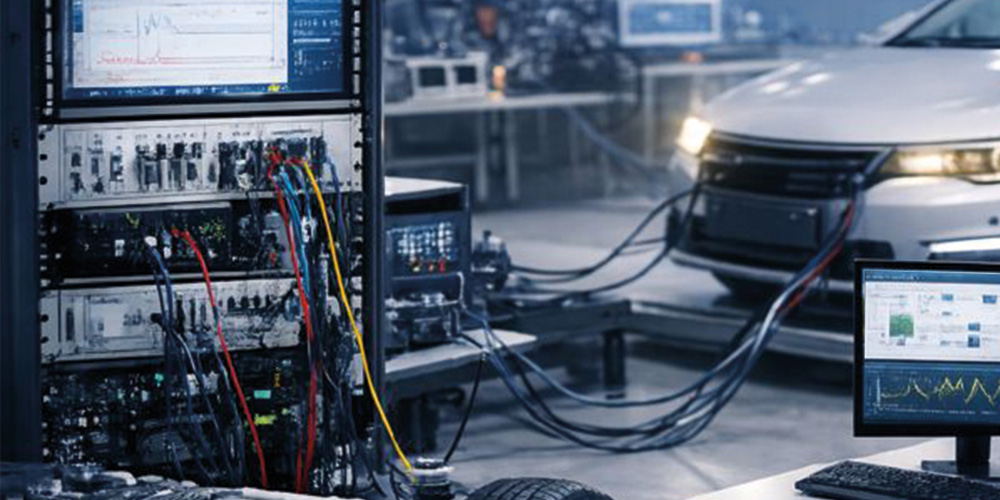
The classic Hardware-in-the-Loop (HIL) system represents the highest level of integration among automotive test environments. It relies on a powerful real-time computer that simulates the vehicle's physical and logical models. Combined with numerous I/O modules, galvanic isolation, and CAN, LIN, FlexRay, or Automotive Ethernet connectivity, it realistically stimulates all sensor signals, actuator commands, and protocols, and injects genuine faults. These cabinet-mounted, fixed systems aim for complete validation. Their size and complexity require specialized staff and long commissioning times, but in return offer the highest precision, test depth, reproducibility, and scalability. They are used in particular for safety functions (airbags, ESP, driving aids) or full ECU system certification.
Targeted and flexible: the miniHIL systems
The miniHIL is a more compact variant, reduced to the essentials. It forgoes complex simulation models to focus on functional testing of individual ECUs or subsystems. By reducing the number of I/O channels and simplifying signal conditioning, it becomes significantly smaller and more affordable. Its strengths: fast commissioning, high flexibility, better adaptability. Manufacturers often consider traditional HIL systems too complex and too slow — "a sledgehammer to crack a nut." The miniHIL strikes the right balance: the functionality needed for validation, but much simpler to implement. Ideal for functional and integration testing in early stages, or for regression testing.
Compact intelligence: microHIL systems
The latest innovation is the microHIL class: highly integrated, standalone test platforms designed for communication and functional testing. Unlike miniHIL, which often still depends on PC-based simulation, a microHIL operates fully independently: it runs residual bus simulations, signal manipulation, and test scripts directly on the hardware, without an external computer. Fewer I/O channels, but extremely short turnaround times, high configurability, and testing right at the bench or workstation. Ideal for rapid prototyping, production validation, and end-of-line testing.
A notable example: HMS's Ixxat Mobilizer, a standalone microHIL that integrates several protocols — CAN, CAN FD, LIN, FlexRay, Automotive Ethernet and EtherCAT — into a compact and rugged hardware unit. Configurable without programming via the Advanced Configuration Tool (ACT), it independently performs residual bus simulation, logging and gateway functions. It bridges the gap between complex lab HIL systems and lightweight miniHIL systems. Test management is handled by external tools (ecu.test, Robot Framework), which keeps the system more open at the cost of additional integration, but with reduced turnaround times and implementation costs.
Comparison of the three classes
| Aspect | HIL | miniHIL | microHIL |
|---|---|---|---|
| Size | Large, multi-cabinet, fixed | Compact, semi-modular | Very compact, portable / embeddable |
| Simulation | High-precision real time (µs) | Soft real time (ms) | Standalone, without full real-time simulation |
| I/O capacity | Very comprehensive (analog, digital, PWM) | Selective signals | Minimalist, communication-focused |
| Networks | Complete residual bus simulation | Partial | Multi-protocol integrated |
| Test depth | System validation & security | Functional & integration | Communication & component |
| Implementation | High (weeks to months) | Medium (days to weeks) | Low (within a few hours) |
| Cost | Very high | Medium to low | Low |
The three systems do not replace one another: they complement each other. HIL offers the greatest test depth, while miniHIL and microHIL score points on speed, flexibility, and cost savings — depending on the test environment and customer needs.
Conclusion
HIL, miniHIL, and microHIL form a graduated spectrum of modern test strategies. Classic HIL ensures complete system validation, indispensable for critical applications; miniHIL offers an agile, cost-effective alternative for functional and integration testing; microHIL, such as the Ixxat Mobilizer, bridges the gap between development and production testing. Openness, modularity, and short response times make test strategies more flexible, efficient, and future-proof.