CAN XL
The next evolution of CAN communication
For more than thirty years, the Controller Area Network (CAN) has been the backbone of communication in vehicles and numerous industrial applications. Starting with classic CAN, which established a robust, cost-effective bus system, the technology was then extended with CAN FD to allow faster data transmission and significantly larger payloads. Now, with CAN XL, the third generation of the protocol has arrived. Building on the same physical foundation, it introduces decisive improvements in data rate, payload size and integration flexibility, bringing CAN into the era of zonal architectures and IP-based communication.
From Classical CAN to CAN XL
CAN development has always been driven by growing bandwidth and efficiency requirements. Classic CAN offered up to 1 Mbit/s and eight data bytes per frame, which was sufficient for many years. CAN FD extended this to 64 data bytes and allowed flexible bit rate switching in the data phase, reaching up to 8 Mbit/s.
CAN XL now continues along this path by supporting payloads of up to 2,048 bytes per frame and data rates of up to 20 Mbit/s in fast mode. With these capabilities, CAN XL not only surpasses its predecessors but also positions itself as a bridging technology between traditional fieldbuses and high-speed Ethernet networks.
Frame structure and format
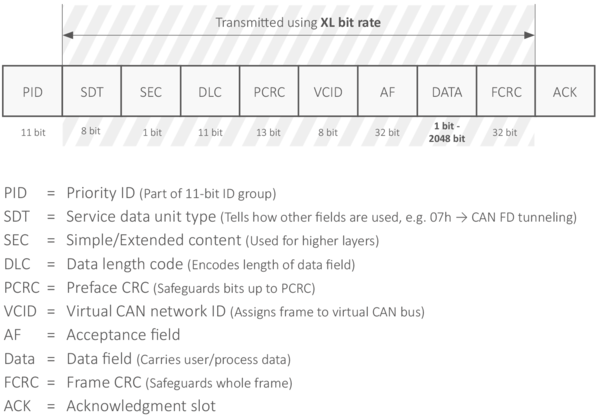
At the heart of CAN XL lies the XL Frame Format (XLFF), which extends the familiar CAN frame structure. One of the most significant innovations is the split of the identifier into two parts. The 11-bit priority identifier is used for arbitration, while the 32-bit acceptance field serves as a flexible addressing and filtering mechanism. This split allows messages to be prioritized and routed more efficiently.
The frame structure also introduces additional fields that extend the protocol's versatility:
- The Service Data Unit Type (SDT) defines which upper-layer protocol is being carried, enabling CAN FD tunneling or IP packet transmission.
- The Virtual CAN Network ID (VCID) allows up to 256 logical networks to run on a single physical segment, similar to VLANs in Ethernet.
- The Simple Extended Content (SEC) bit indicates whether additional headers, such as for encryption or fragmentation, are included.
Together, these features allow CAN XL to act as a highly adaptable platform supporting both existing applications and modern data-oriented architectures.
CAN XL frame format
Data integrity and reliability
As data fields grow larger, ensuring reliability becomes even more critical. CAN XL introduces two cyclic redundancy check fields to secure transmissions: the Preface CRC protects the control information, while the Frame CRC secures the entire frame. This cascaded approach achieves a Hamming distance of six, meaning up to five randomly distributed bit errors can be reliably detected. Such robustness is essential when transporting large payloads or safety-critical data in automotive and industrial environments.
Physical layer and mode switching
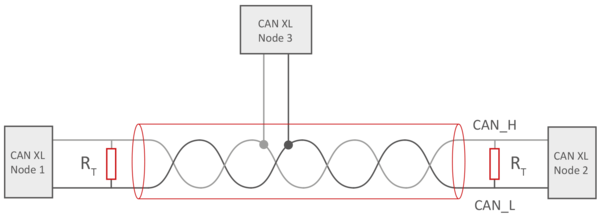
One of CAN XL's strengths lies in its ability to reuse existing physical infrastructure. Like its predecessors, it relies on a two-wire twisted-pair bus with 120-ohm termination. This means that in many cases existing wiring can be retained, easing migration.
Typical CAN XL wiring
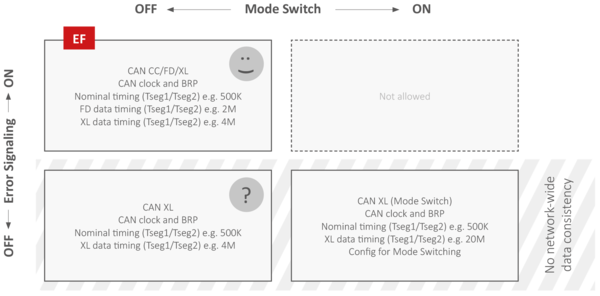
To achieve data rates above 8 Mbit/s, CAN XL introduces the concept of mode switching combined with the new SIC XL transceivers. During the arbitration phase, communication still follows the conventional scheme, but for the data phase, the system can switch to a fast push-pull mode with reduced signal amplitude. This enables bit rates of up to 20 Mbit/s while maintaining the reliability of the CAN transmission principle.
Mode switching enables high data rates with strong robustness. The additional fields in the CAN XL frame provide structured meta-information for processing in the higher protocol layers.
Advanced features
Beyond speed and payload, CAN XL introduces optional enhancements that prepare the protocol for future challenges:
- CANsec — a security extension designed to protect against cyberattacks. It embeds authentication data directly in the frame and secures the communication channel without requiring higher-layer security solutions.
- Frame fragmentation — allows very large frames to be interrupted so that high-priority control messages can get through without compromising the integrity of the larger transmission.
- Pulse width modulation coding (PWM) — as an alternative to the traditional NRZ method, further extending possible bit rates depending on network design.
Standardization and ecosystem
CAN XL has been officially standardized in ISO 11898-1:2024. Additional specifications, guidelines, and recommendations are being developed by CAN in Automation (CiA), covering aspects such as test plans, higher-layer services, application notes, and additional security concepts. This ensures a solid foundation for the technology and gives manufacturers and suppliers a clear framework for implementation.
Advantages and challenges
The key advantages of CAN XL lie in its combination of high data capacity and backward compatibility. With up to 2,048 bytes per frame, not only sensor data but also IP packets can be transmitted efficiently. At the same time, existing CAN infrastructures can be used, enabling mixed environments with Classic, FD, and XL.
Particularly valuable for the future is the ability to create virtual networks with VCID, enabling zonal architectures that allow load balancing and targeted quality assurance of data traffic.
However, this extended functionality also presents challenges. The complexity of protocol evaluation increases, and for high bit rates beyond 8 Mbps, mode switching is required, which limits traditional mechanisms such as error frames.
CAN XL compared to automotive Ethernet
It is tempting to directly compare CAN XL with automotive Ethernet, since both are candidates for high-performance networking in vehicles. Ethernet reaches much higher bit rates, up to 10 Gbit/s, and is therefore the preferred choice for high-bandwidth applications such as infotainment or backbone connections.
CAN XL, on the other hand, offers payloads of up to 2,048 bytes — more than the standard Ethernet MTU of 1,500 bytes — and excels in deterministic, cost-sensitive environments. While Ethernet typically requires star or ring topologies, CAN XL continues to operate on simple linear structures, which helps reduce wiring complexity.
Rather than competing directly, the two technologies complement each other: Ethernet for ultra-high-bandwidth domains, CAN XL for zonal architectures, sensor data aggregation, and seamless integration with existing CAN networks.
Applications and outlook
The main application area of CAN XL is in vehicle zonal architectures, where electronic control units within a functional zone communicate locally and forward aggregated data to central processors. This approach reduces wiring effort, supports modular designs, and adapts perfectly to the flexibility of CAN XL.
Another key use case is the efficient transmission of large sensor data streams, for example in advanced driver assistance systems (ADAS), where numerous signals must be combined and processed. Beyond the automotive sector, CAN XL is also well suited to industrial automation, serving as a robust backbone network technology.
With tool manufacturers and hardware suppliers already offering starter kits combining interfaces, transceivers, and software APIs, developers can already start exploring the practical benefits of CAN XL today.
CAN XL / automotive Ethernet comparison
| Specification | CAN XL | Automotive Ethernet |
|---|---|---|
| Max bit rate. | Up to 20 Mbit/s | Up to 10 Gbit/s |
| Payload size | Up to 2,048 bytes | Typically 1,500 bytes (MTU) |
| Transmission medium | Twisted pair (120 Ω) | Twisted pair, coaxial, fiber |
| Typical topology | Line with small stars | Star, tree, ring |
| Main use cases | Zonal architectures, tunneling, sensor fusion | Infotainment, backbone, high-bandwidth applications |
| Backward compatibility | Complete with CAN CC and CAN FD | None |
A project? A question?
Discover our catalog or contact our engineering department for tailored support.
View the catalog Contact us