LIN (Local Interconnect Network)
Local Interconnect Network
LIN (Local Interconnect Network) is a cost-effective serial communication system designed for networking simple electronic assemblies in vehicles. It is particularly suitable when sensors and actuators need to be interconnected but the performance and cost of a CAN (Controller Area Network) network are not justified.
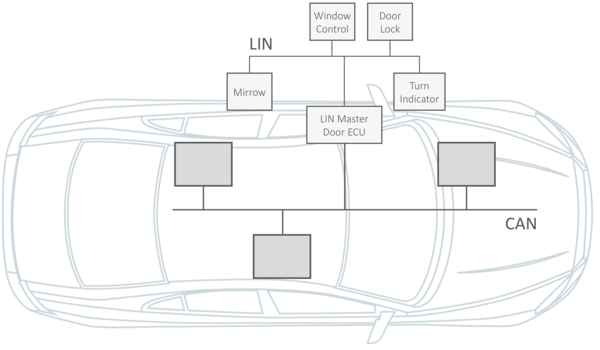
LIN is often used in subsystems such as doors, windows, seats, steering wheel modules, and climate control systems. These subsystems are typically connected to a higher-level CAN network (e.g., body or chassis domain), ensuring that diagnostic and service tools relying on CAN can still access devices connected via LIN. This layered approach enables flexible, hierarchical communication in modern vehicles.
Communication principle
LIN uses a single-wire serial communication protocol based on the UART/SCI (Universal Asynchronous Receiver/Transmitter) interface. Communication is coordinated by a single master node, ensuring predictable response times and latency. A key feature is that slave devices synchronize their clocks directly from the bus signals, enabling low-cost hardware designs with inexpensive oscillators.
The electrical physical layer operates on a single-wire 12/24 V line with a maximum data rate of 20 kbit/s. Although limited in bandwidth, this is more than sufficient for typical control tasks in automotive comfort and body electronics.
A typical LIN cluster contains one master and up to 15 slaves (16 nodes in total) as defined by the LIN specification. Its simplicity, clock synchronization mechanism, and reliance on a single-wire medium make LIN an attractive, cost-effective solution compared to more complex automotive networks.
LIN frame format
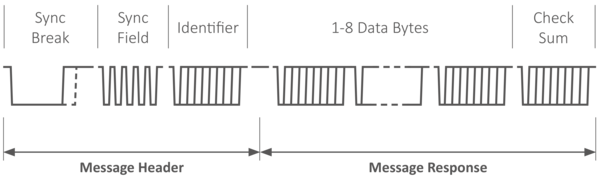
The LIN message frame begins with a sync break — a 13-bit dominant level sent by the master, signaling the start of communication. This is followed by a sync field (alternating 1/0), which allows all slaves to adjust their internal clocks.
Next, the master transmits the identifier field, made up of a 6-bit message ID and a 2-bit parity check. The identifier defines which slave node must respond and how long the message will be (2, 4 or 8 bytes). The addressed slave then sends its data payload (1-8 bytes), followed by a checksum. LIN protocol version 1.3 uses a classic checksum, whereas version 2.0 introduced an enhanced checksum for better error detection.
LIN message frame
In LIN, different frame types exist for communication, each designed to meet specific needs:
- Unconditional frame: Assigned to a unique identifier, it always gets a response from the designated slave. Typically used for cyclic signals such as seat position, window status or mirror adjustment.
- Event-triggered frame: Introduced in LIN 2.0, several signals share an identifier and only the slave with updated data responds. Particularly useful for functions that rarely change, such as door switches.
- Sporadic frame: Directly controlled by the master, transmitted only when a particular piece of information needs to be updated. Suited to rare or irregular events.
- Diagnostic frame: (IDs 60/61) Reserved for service and configuration purposes, with a fixed length of eight data bytes. Used to read diagnostic information, adjust parameters or perform software updates in accordance with ISO 17987.
- User-defined frames: (ID 62) Give developers the flexibility to implement custom communication structures outside the standard frame schedule.
By combining these different frame types within a network, LIN offers a balance between efficiency and flexibility.
Applications and use cases
LIN is typically applied in scenarios where cost and simplicity matter more than high bandwidth. Typical automotive applications include:
- Power windows, mirror adjustment, and sunroof control
- Seat position adjustment and memory
- Wiper systems, rain/light sensors, and climate control units
- Steering wheel buttons and infotainment controls
LIN-based door subsystem connected to the main CAN network
By handling these comfort and body functions, LIN reduces the load on CAN and other high-performance networks, while maintaining reliable communication. Outside the automotive field, LIN has also been adopted in certain industrial and household appliance applications, where similar cost and simplicity considerations apply.
A project? A question?
Discover our catalog or contact our engineering department for tailored support.
View the catalog Contact us