Firmware flashing of battery ECUs with DoIP & ISO-TP gateways

DoIP gateways significantly speed up the flashing of battery ECUs: diagnostic data travels over high-speed Ethernet (ISO 13400), while ISO-TP reliably transports large packets over CAN/CAN FD. The result: lower latency, cycle times met, compatible updates, and improved security.
In modern vehicles — particularly electric drivetrains — reliable, fast programming of control units (ECUs) is crucial. Whether at end-of-line testing or in the field via updates, firmware flashing determines efficiency, productivity and therefore competitiveness. Yet flashing processes often exceed the cycle times imposed by the manufacturer, a problem made worse by ever-larger software packages. Two key technologies — DoIP and ISO-TP — address this challenge.
The challenge: production cycle times
In battery production, every second counts. Controllers must be programmed during the production flow without interrupting it. Traditionally, flashing goes through CAN or CAN FD — widely used but with limited bandwidth. Earlier approaches pre-processed data on the PC and then transmitted it as individual CAN messages, resulting in higher latencies and unnecessary delays. For integrators and suppliers, exceeding the required cycle time is a costly risk. Manufacturers, for their part, demand reliable solutions that integrate with existing systems and are future-proof. DoIP gateways have established themselves as a proven answer.
What is Diagnostics over IP (DoIP)?
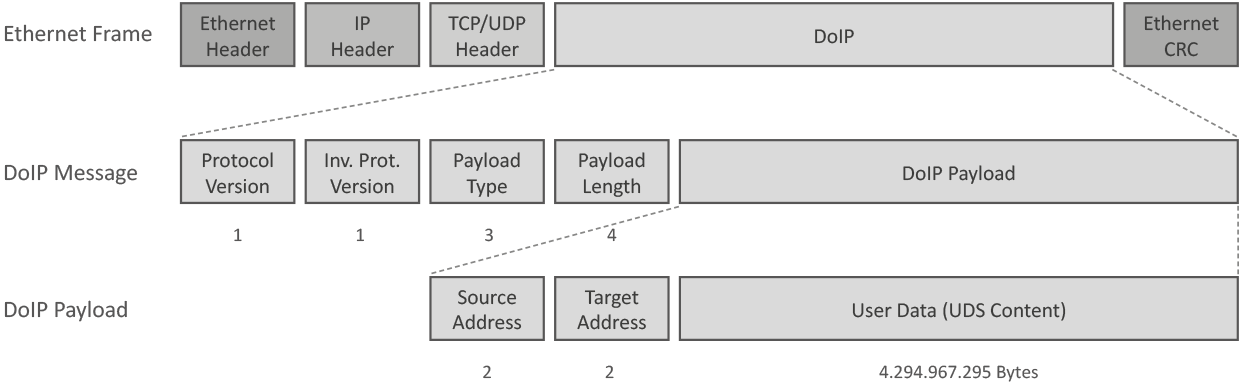
DoIP, standardized in ISO 13400, defines the transmission of diagnostic data over Ethernet networks. Unlike classic CAN communication, it relies on the TCP/IP protocol, well established in the IT world, and enables high bit rates with low latency. With Ethernet as the physical layer, bandwidths of 100 Mbit/s to 1 Gbit/s are reached — a leap compared to classic CAN and CAN FD buses (1 to 8 Mbit/s).
DoIP also offers standardized mechanisms for addressing and identifying ECUs, allowing several controllers to be addressed in parallel — crucial for complex battery systems with many sub-modules. It also continues to support the familiar UDS services (ISO 14229) unchanged: existing diagnostic and flashing tools remain usable without changing application logic. Technically, DoIP relies on OSI layers 2 to 4: Ethernet, IP for addressing, TCP or UDP for transport.
The role of ISO-TP
ISO-TP (ISO 15765-2, "Transport Protocol") for CAN and CAN FD splits large firmware files into smaller frames, numbers and acknowledges them, then reassembles them correctly at the receiver. This enables reliable flashing of files several hundred megabytes in size. In a DoIP gateway, it ensures timing and sequencing are respected on the CAN bus. Another benefit of DoIP combined with ISO-TP: the ability to integrate security mechanisms such as TLS, which protect flashing and diagnostics against unauthorized access — an increasingly important aspect for remote updates.
The DoIP gateway, a bridge between two worlds
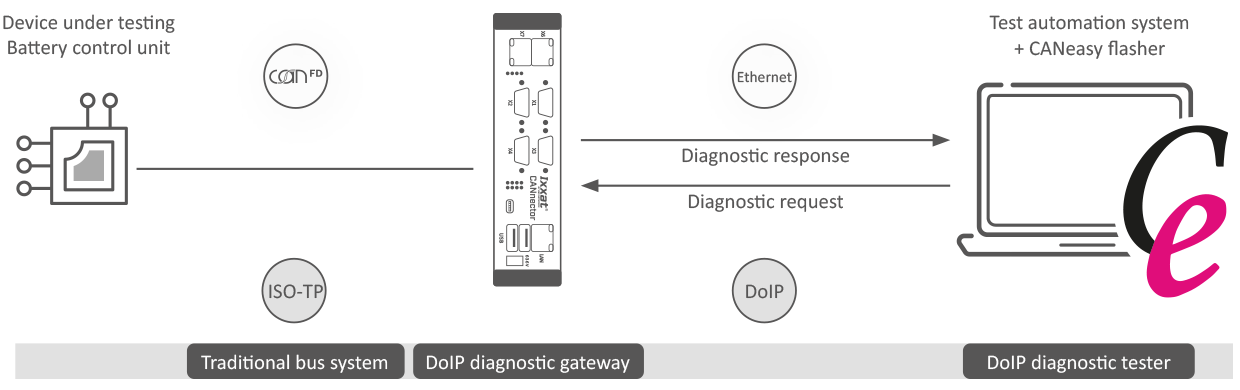
Many ECUs do not have their own Ethernet interface: an intermediate DoIP gateway is required. It receives DoIP packets from the diagnostic tester, converts them into CAN or CAN FD messages, and sends the ECU's responses back to the Ethernet network. Even ECUs without Ethernet can thus be integrated into modern diagnostic and flashing environments.
A good example of a high-performance DoIP gateway is the CANnector Automotive Gateway from Ixxat (HMS), which operates in standalone mode and supports both DoIP and ISO-TP. Combined with the CANeasy test software, into which ODX and PDX flash containers can be imported directly, it forms a powerful solution. The practical benefit is clear: in a recent application, a time saving of around 20% was achieved, as data processing takes place directly in the gateway rather than on the PC. Via the Advanced Configuration Tool (ACT), the gateway is very easy to configure and seamlessly integrates existing ARXML files. Alongside flashing, diagnostic, logging, or residual bus simulation tasks can be carried out without interrupting the process.
Conclusion
Flashing the firmware of battery ECUs remains a key task in electromobility. Where classic CAN methods reach their limits, DoIP gateways offer an efficient, future-proof solution, bridging traditional buses and modern Ethernet protocols — so that production lines meet their cycle times. New standards such as SAE J1979-3 specify electric vehicle diagnostic functions over DoIP, making Software-Defined Vehicles (SDVs) a reality.