Stabilization of a CAN network on an electric tractor
Electric vehicle design
Unstable CAN network with random dropouts
PCAN-Repeater DR, PCAN-Router Pro
The problem
A manufacturer specializing in the design of electric tractors was facing a critical issue: the vehicle's CAN network would randomly collapse, causing a total communication breakdown between the various control units (ECUs).
These interruptions temporarily rendered the vehicle inoperative and called into question the reliability of the entire onboard electronic architecture.
Diagnostics
After a full analysis of the CAN network, PEAK-System France identified several combined causes:
- Unsuitable cabling: the cable type used was not designed to withstand the electromagnetic stresses specific to a high-power electric vehicle.
- Incorrect wiring architecture: the ECUs were not connected in a bus topology compliant with CAN best practices (excessive stubs, poorly positioned termination resistors).
- EMC disturbances from inverters: the power inverters generated electromagnetic interference that polluted the CAN bus, causing numerous error frames.
- Electrical insulation faults: insulation issues between the motor, battery packs, inverters and chassis created parasitic ground loops.
The solution
The intervention took place in three phases:
1. CAN wiring reuse
The wiring was replaced with shielded twisted pairs suited to the EMC constraints of an electric vehicle. The architecture was redesigned to connect each control unit directly to the main bus, without unnecessary branches. The termination resistors (120 Ω) were repositioned at both ends of the bus.
2. Galvanic isolation with the PCAN-Repeater DR
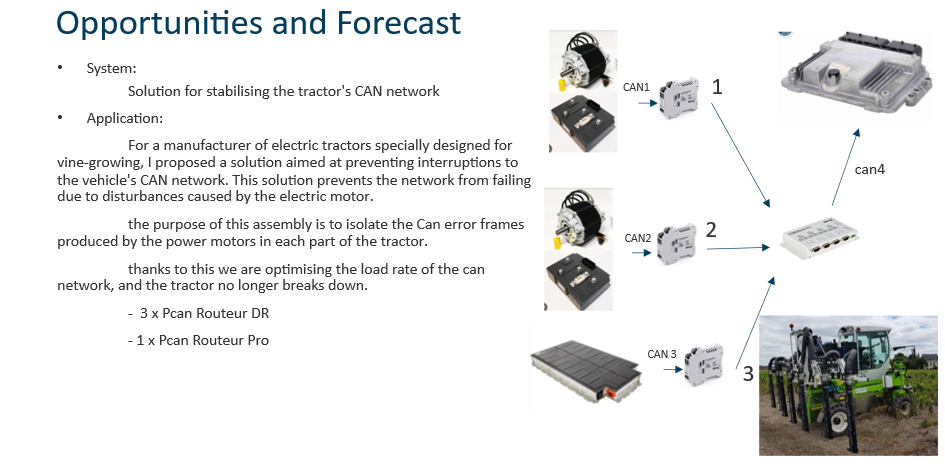
PCAN-Repeater DR modules were installed between the power drives and the rest of the CAN network. This galvanic isolation made it possible to drastically reduce error frames by isolating electromagnetic interference generated by the drives.
3. Smart filtering with the PCAN-Router Pro
To optimize network load and improve overall performance, a PCAN-Router Pro was deployed. This router filters and routes CAN messages so that each ECU only receives the frames intended for it, reducing unnecessary traffic and the risk of collisions.
The result
The CAN network has become perfectly stable. Unexpected communication dropouts have been completely eliminated. The manufacturer now has a robust network architecture, reproducible across its entire range of electric tractors.