LIN communication: the PLIN-USB speeds up air conditioning development
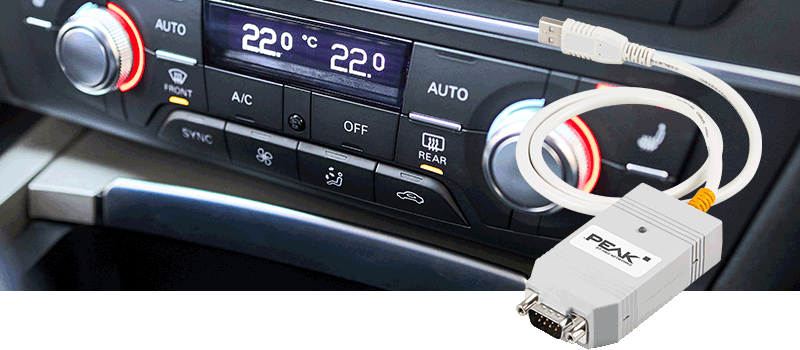
Constructeur automobile — climatisation
No visibility into LIN traffic between the BCM and the HVAC system
PLIN-USB, PLIN-View Pro, PLIN-API
The problem
A major Asian automaker wanted to make development of its next-generation air conditioning units more efficient and cost-effective. But during the development and validation phase of an entirely new vehicle platform, the team ran into significant difficulties analyzing and reproducing LIN (Local Interconnect Network) communication between ECUs — particularly between the body control module (BCM) and the new air conditioning unit.
The validation methods used until then provided no reliable view of communication on the bus. Several obstacles compounded one another:
- Lack of real-time visibility into LIN frames: developers had to log traffic to identify signal structures, identifiers and data bytes, then cross-reference this information (temperature, fan speed, air distribution, recirculation) with the LDF specification.
- Inconsistent protocol versions: some modules still used LIN 1.3, others LIN 2.x with improved checksum and diagnostic functions — a source of interpretation errors and communication faults.
In-house solutions based on simple microcontroller boards were not suitable: neither stable communication nor precise timestamping was achieved. The hardware also had to be compact and robust, with validation carried out both on the test bench and on a prototype vehicle.
The solution
The manufacturer chose PEAK-System's PLIN-USB interface, which combines a high-performance LIN interface with the flexibility of a USB connection. The validation setup consisted of a development PC running PLIN-View Pro software, connected to the LIN bus via the PLIN-USB. The BCM simulator (LIN master) and the prototype air conditioning unit (LIN slave) were both connected to the bus.
1. Analysis and recording
PLIN-View Pro displayed and logged messages, identifiers, and data bytes, with communication filtering, frame structure analysis, and graphical signal representation.
2. Automated validation via the PLIN-API
Using the PLIN-API, engineers programmed automated validations in Python: selectively sending, modifying, or replaying LIN messages to verify ECU behavior under defined conditions. Being able not only to passively observe but also to actively intervene on the traffic proved decisive.
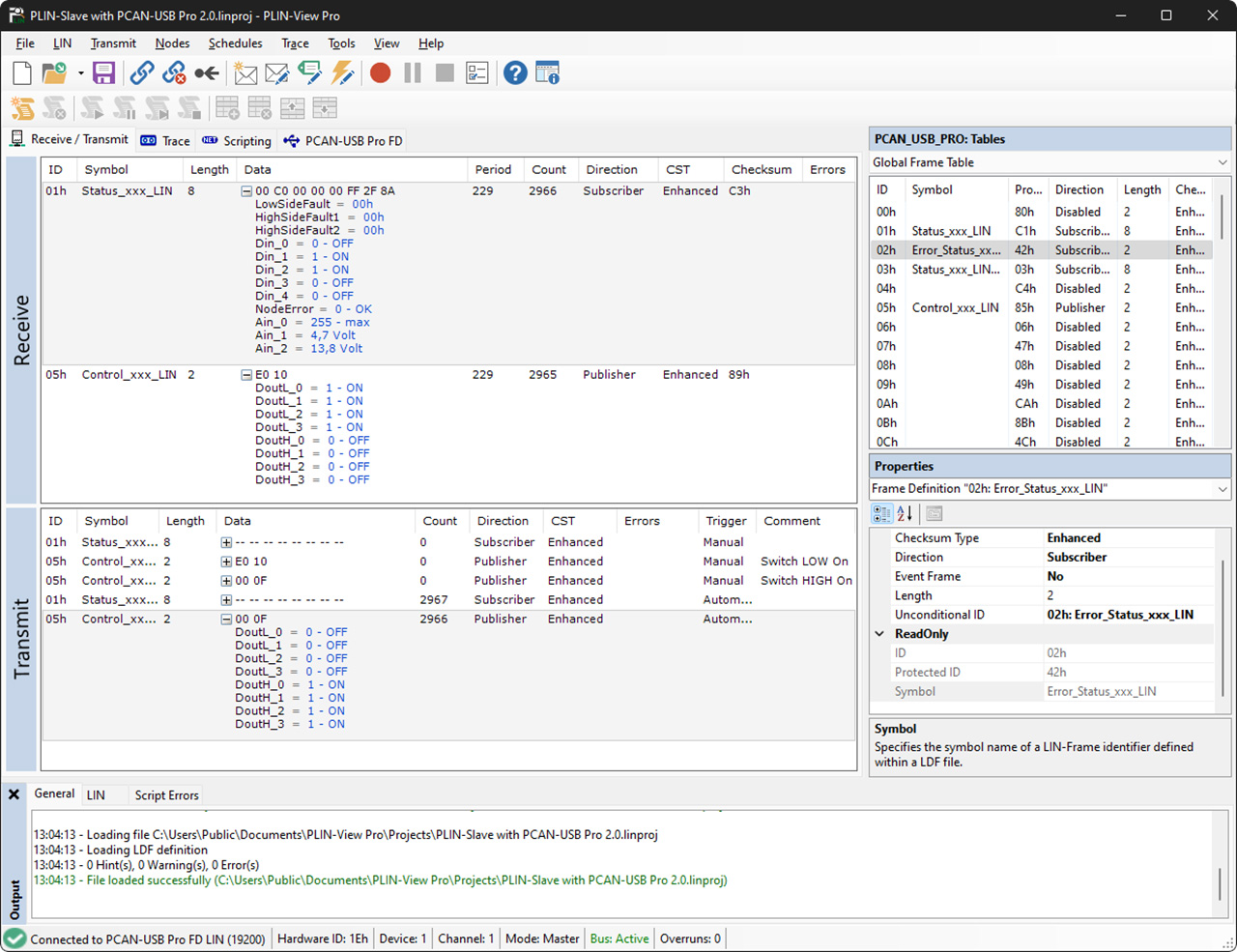
The PLIN-USB interface is compact and rugged: it supports LIN 1.3 to 2.2A, operates as master, slave, or monitor, complies with ISO 17987-4, offers bit rates up to 20 kbit/s, precise timestamps, and direct USB power supply. The free PLIN-View Pro and PLIN-API tools are included.
"With the PLIN-USB, we were able to fully reconstruct the communication between master and slave and document it in a database. Fault analyses that used to take days were reduced to a few hours. And the system moved easily from the lab to the vehicle environment, without complex reconfiguration — that's what finally convinced the customer."
The result
The manufacturer significantly optimized its development processes for air conditioning units. The interface gave developers full transparency into LIN communication, enabling precise analysis and real-time simulation of bus behavior. Engineers benefit from increased measurement reliability and reduced development time.