
CAN FD (Flexible Data Rate)
Why CAN FD?
Growing requirements in terms of number of nodes, transfer rates, and cycle times create bottlenecks that the limitations of classic CAN (8 data bytes and 1 Mbit/s bit rate) cannot satisfy. The bit rate depending on network extension and the short data length for service and analog data play a particular role.
In daily use, these limitations are often worked around with compromises: splitting the system into different network segments — or even into parallel networks — means that existing technology is constantly pushed to its limits, which has often led to solutions that are complex and costly in terms of configuration, commissioning and maintenance.
In principle, a switch to high-performance industrial Ethernet technologies would be possible. However, the generally higher investment required and the change in data structures often represent a considerable challenge. In addition, a change of development, commissioning and service tools is necessary, which often discourages many users from a complete conversion. At the same time, there is a desire to continue making useful use of existing know-how.
This is where CAN FD comes into play: CAN FD (CAN with Flexible Data rate) is an extended version of the well-known "classic" CAN, introduced by Bosch in 2012, which significantly increases the usable data rate and data length. At the same time, the proven CAN concepts have been retained: arbitration based on message identifiers, event-triggered message transmission, and acknowledgment of received messages via the acknowledge bit.
Improved data rate
Message acknowledgment by receivers, used in classic CAN, offers many advantages by confirming successful transmission within the transmitted message — potential transmission errors are quickly detected and data can be retransmitted extremely fast. Message arbitration based on the CAN identifier also offers advantages for control applications by avoiding collisions during data transmission.
The drawback of the methods used is that, at the moment of sampling, the same bus level must exist at all nodes to avoid faults. As a result, a bit interval must provide sufficient signal propagation time between the two most distant nodes on the network. The bit interval, and therefore the data rate, is thus directly dependent on the network's extension; at 40 m extension, up to 1 Mbit/s is possible, but at 250 m extension this drops to 250 kbit/s.
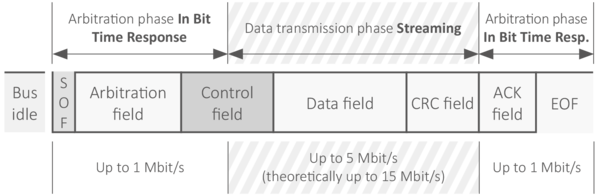
To significantly increase bit rate without changing the existing communication technology, CAN FD works with two different bit rates. The "arbitration bit rate" for control commands depends on the propagation speed and therefore on the network's extension. In contrast, a second "data bit rate" is optionally used — for the data content and data security. At this point, only the message transmitter occupies the bus, meaning that direct feedback within the bit time is not required. The maximum achievable data bit rate therefore depends only on the transmission characteristics of the medium, not on signal propagation. CAN FD networks currently allow productive use at 8 MBit/s, with the CAN FD standard permitting up to 15 Mbit/s.
CAN FD introduces two separate bit rates: the arbitration bit rate governs arbitration, the control fields, and the acknowledgment. Its speed depends on the physical length of the network. The data bit rate applies to the data field and the CRC. Since only the transmitter occupies the bus during this phase, the speed can be increased independently of the network length.
The two data rates are set independently of each other in the CAN FD controller via two bit timing registers. Switching between the two rates is performed using two control bits in the protocol. The first previously reserved bit is used as the "Extended Data Length" (EDL) bit, and defines a CAN FD message by its recessive level. The actual rate switch is performed by a new bit, the "Bit Rate Switch" (BRS) bit.
Extended user data
Control data is always transmitted at the known lower bit rates, thereby limiting achievable data rates. By increasing the user data area up to 64 bytes, more data can be sent in fast transfer mode, effectively increasing the data rate.
Classic CAN provides only 8 bytes of data, which is no longer sufficient for many data applications, e.g., transmitting high-precision analog values or controlling a multi-axis robot. On top of this, service data has so far significantly reduced efficiency due to the transport protocols required for transmitting more than 8 bytes.
CAN FD now offers the ability to use up to 64 data bytes. This means larger data blocks can be transmitted in a single message. For service data, the need for transport protocols is reduced, since a single CAN FD message is often sufficient for configuration data.
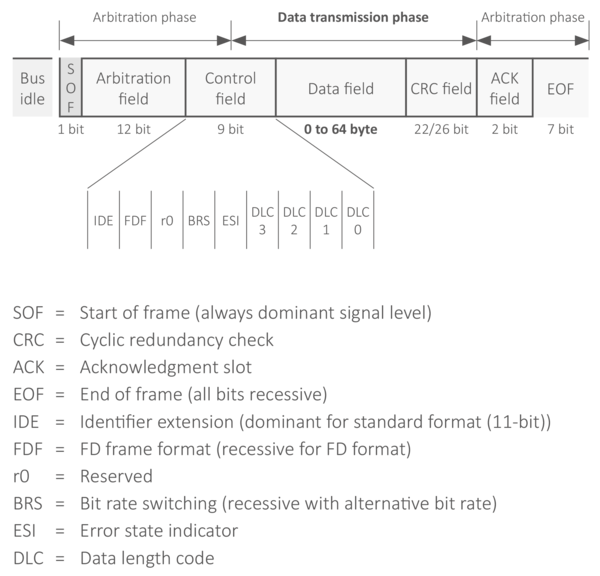
To avoid unnecessarily extending the control data, CAN FD also uses only 4 bits for the data length code — values 0 to 8 are taken directly from Classic CAN. The previously undefined values (9 to 15) are used for the new extended data lengths: in addition to 0 to 8 bytes, 12, 16, 20, 24, 32, 48, and 64 bytes are now available for user data.
In addition to the fast transmission of the data field, the effectively usable data rate can be significantly increased with CAN FD. Thus, a CAN FD network with 500 kBit arbitration, 4 MBit data transmission, and 64 bytes of data can achieve an effective rate of over 5 MBit/s.
The CAN FD frame with all its elements and meanings
Real-time capability
Combining several independent data packets into a single message greatly simplifies data administration, since individual messages no longer need to be synchronized with each other at great effort. Fast transmission of larger data packets compared to classic CAN allows 8 times the data volume (64 bytes) to be transferred in roughly the same time required for a classic 8-byte CAN message. In this way, high-priority messages can be transmitted much faster and real-time capability is improved.
Data security
Data security is an important topic: despite the increased data packet size compared to classic CAN, CAN FD meets the same data security requirements. This is achieved by using longer CRC check keys with suitable algorithms. Depending on the number of data bytes transmitted, one of three different CRC algorithms is used: the previous CRC formula for messages up to 8 data bytes, plus two improved algorithms for messages up to 16 bytes or more than 16 bytes.
For improved data security, additional recommendations were implemented. As a result, the CRC in CAN FD messages always starts with a stuff bit; after 5 additional bits, an extra stuff bit is included — unlike the standard CAN stuffing rule, this one is independent of the values of the preceding bits.
Backward compatibility
One drawback of moving from CAN to faster communication systems is that a complete conversion is often required: all CAN participants must be adapted to the new system. By using CAN FD, a "gentler" option is now available: since CAN FD controllers can also be used as classic CAN nodes, all nodes in the network can be gradually replaced with CAN FD-compatible devices. Once the entire network is CAN FD-compatible, the benefits of CAN FD can be fully exploited.
With the release of various hardware and software products, PEAK-System is a pioneer in the introduction of the CAN FD standard.
With CAN FD (Flexible Data rate), the robust and proven CAN specification was extended with properties mainly designed for larger amounts of data. Higher bit rates of up to 12 Mbit/s for CAN frame data and the use of up to 64 data bytes in a single CAN frame are the main criteria.
CAN FD is backward compatible with the CAN 2.0 A/B standard, so CAN FD nodes can be used in existing CAN networks. However, in this case, the CAN FD extensions do not apply.
Since the first CAN FD implementations, the protocol has been improved and is now included in the ISO 11898-1 standard. PEAK-System takes this into account by supporting both versions of the protocol with its CAN FD interfaces ("Non-ISO" and "ISO").
Products with CAN FD support
PEAK-System is progressively expanding its CAN product range with CAN FD compatibility.
| Article | Ref. | Notes |
|---|---|---|
| PCAN-USB FD | IPEH-004022 | |
| PCAN-USB Pro FD | IPEH-004061 | |
| PCAN-USB X6 | IPEH-004062 / 004063 / 004064 | |
| PCAN-PCI Express FD | IPEH-004026 / 004027 / 004040 | |
| PCAN-miniPCIe FD | IPEH-004045 / 004046 / 004047 | |
| PCAN-M.2 | IPEH-004083 / 004084 / 004085 | |
| PCAN-PCI/104-Express FD | IPEH-004080 / 004081 / 004082 | |
| PCAN-MicroMod FD | IPEH-003080 | |
| PCAN-MicroMod FD Evaluation | IPEH-003081 / 003082 | |
| PCAN-MicroMod FD Analog 1 | IPEH-003087 | |
| PCAN-MicroMod FD Digital 1 & 2 | IPEH-003083 / 003084 | |
| PCAN-MicroMod FD ECU | IPEH-003085 | |
| PCAN-MicroMod FD Configuration | - | |
| MU-Thermocouple1 CAN FD | IPEH-004005-J / K / T | |
| Thermocouple FD Configuration | - | |
| PCAN-GPS FD | IPEH-003110 | |
| PCAN-GPS Pro FD | IPEH-003105 | |
| PCAN-Chip USB | IPEH-004025 | |
| PCAN-Router FD | IPEH-002214 / 002215 | |
| PCAN-Router Pro FD | IPEH-002220 / 002222 | |
| PCAN-Ethernet Gateway FD DR | IPEH-004012 | |
| PCAN-Diag FD | IPEH-003069 | |
| PCAN-MiniDiag FD | IPEH-003070 | |
| PCAN-Explorer 6 | IPES-006000 / 006090 | |
| PCAN-View 4 | - | |
| Bit Rate Calculation Tool | - | |
| CAN FD Frame Analyzer | - | |
| PCAN-Developer 4 | IPES-004070 | |
| PCAN-Basic 4 | - | |
| PCAN-XCP | - | |
| PCAN-PassThru API | - | |
| PCAN-ISO-TP API | - | |
| PCAN-UDS API | - |
CAN FD compatible products
Some of our existing CAN products can work with the CAN FD standard, due to their operating principle.
| Article | Ref. | Notes |
|---|---|---|
| PCAN-LWL | IPEH-002026 | Suitable for use on CAN FD buses with data bit rates up to 5 Mbit/s and nominal bit rates up to 500 kbit/s |
| PCAN-Optoadapter | IPEH-002038 | Suitable for use on CAN FD buses with data bit rates up to 2 Mbit/s and nominal bit rates up to 1 Mbit/s |
| PCAN-Repeater DR | IPEH-004038 | Suitable for use on CAN FD buses with data bit rates up to 4 Mbit/s and nominal bit rates up to 1 Mbit/s |
| PCAN-(Mini)Term | IPEK-003002 | |
| PCAN-(Mini-)T-Adapter | IPEK-003003 | |
| PCAN-Adapter D-Sub for DR products | IPEK-003012 | |
| PCAN-Cable 1 | IPEK-003000 | |
| PCAN-Cable 2 | IPEK-003001 | |
| PCAN-Cable 3 | IPEK-003011 | |
| PCAN-Cable M12 | IPEK-003016 | |
| LIN connection cable for PCAN-LIN | IPEK-003008 | |
| LIN connection cable for LIN PC interfaces | IPEK-003013 |
A project? A question?
Discover our catalog or contact our engineering department for tailored support.
View the catalog Contact us