Reliable CAN communication for autonomous driving
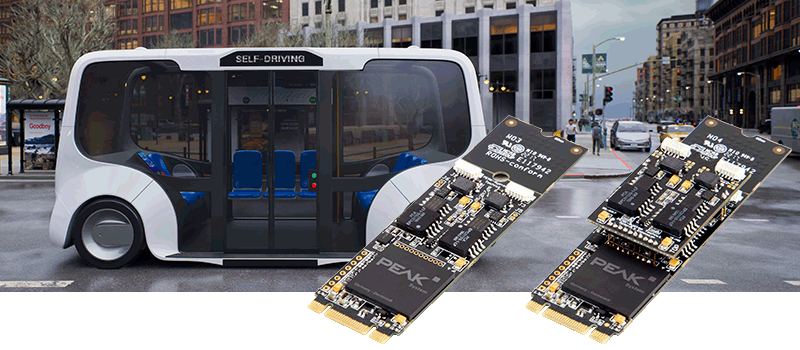
ADLINK Technology (calculateur ADM-AL30)
Deterministic, fault-tolerant CAN/CAN FD communication
PCAN-M.2 (4 canaux)
The problem
Level 4 autonomous driving requires high-performance, deterministic, fault-tolerant data communication between numerous sensors and ECUs. The integrator developing autonomous shuttles needed to fuse LiDAR, radar, and camera data in real time in a complex urban environment, make instant decisions, and communicate safely with the vehicle's systems.
The central control unit (ECU) needed a robust, standards-compliant, low-latency link to the periphery of the vehicle via the CAN bus. However, industrial PCs often lack native support for CAN 2.0 and CAN FD, as well as the required electromagnetic compatibility and mechanical robustness. The solution also had to meet E-Mark (ECE R10) certification and ISO standards (ISO 7637-2, ISO 16750-2), in a compact form factor that could be integrated directly into the ECU.
The solution
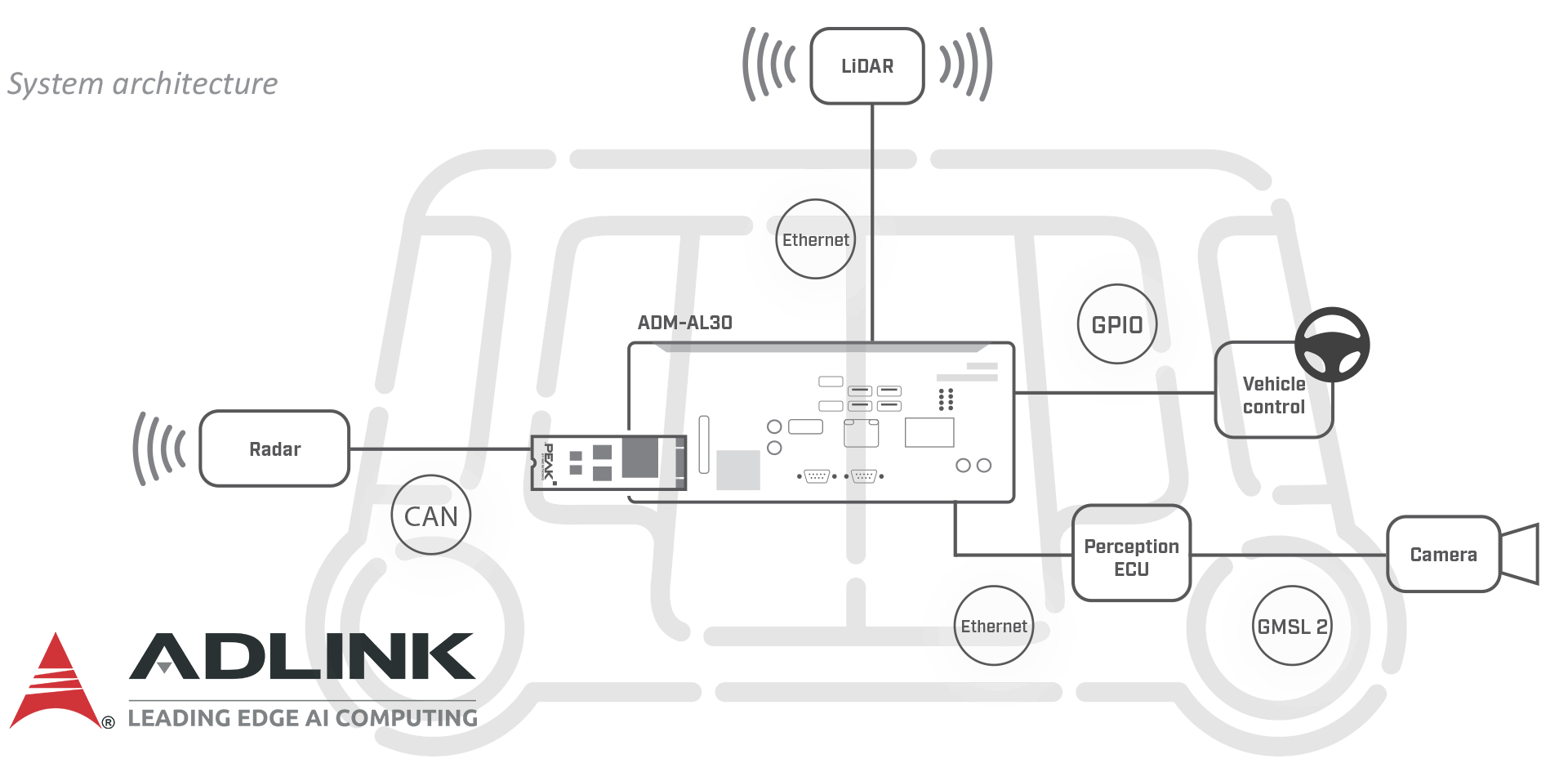
ADLINK Technology has integrated the four-channel PCAN-M.2 interface into its ADM-AL30 computer, which combines an Intel Core i9/i7 (12th generation) processor with an NVIDIA RTX 4000 SFF GPU, running Ubuntu 22.04 with ROS 2.0 or Autoware.
1. Multi-channel connectivity
The PCAN-M.2 offers up to four independent CAN channels, supporting both classic CAN 2.0 A/B and high-speed CAN FD. LiDAR data is carried over Ethernet, camera streams over GMSL 2 to a dedicated perception ECU, and steering commands are issued via the GPIO interfaces.
2. Compact and robust format
With its dimensions of 80 × 22 × 10.2 mm and M.2 PCIe connection, the board fits into a minimal footprint and resists vibration — a decisive advantage for direct integration into the embedded ECU.
3. Native software integration
Native SocketCAN support on Linux enables seamless integration into ROS 2.0 / Autoware systems, without a proprietary driver.
The result
ADLINK provides reliable vehicle communication: four channels ensure stable CAN/CAN FD transfer, software integration is native via SocketCAN, and the automotive-grade M.2 form factor offers robustness and strong EMC immunity. Parallel multi-channel processing supports the sensor fusion and real-time decision-making required for autonomous driving.