Flashing battery system control units through a DoIP gateway

Battery system production and testing
Meeting the cycle times imposed on end-of-line flashing
Ixxat CANnector, CANeasy, ACT
The problem
At the end of a battery system production line, the coordination of cycle times, flash synchronization and data transmission speed are decisive. Being able to flash battery control units (ECUs) in the ongoing production process directly determines whether the required rates can be met. A Chinese system integrator, a recognized specialist in automation for battery production and testing, faced exactly this constraint.
The existing solution worked flawlessly from a technical point of view, but it made poor use of the CAN FD bandwidth: the CAN packets were prepared upstream in the PC software, which lengthened transmission latency. Given the very short cycle times of electric vehicle batteries, the potential saving per unit produced is considerable. Control units are usually flashed over CAN or CAN FD and have no Ethernet interface of their own. The test software in use, CANeasy, however already supports DoIP (Diagnostics over IP), a standardized TCP/IP-based transport protocol for UDS services that allows high data rates.
The aim was therefore to establish efficient communication between the traditional CAN bus of the control unit and the Ethernet-based DoIP protocol of the diagnostic tester, by means of a DoIP gateway.
The solution
To shorten flash cycles, the DoIP (ISO 13400-2:2019) transport protocol was implemented in the CANnector itself.
1. The CANnector as a DoIP gateway
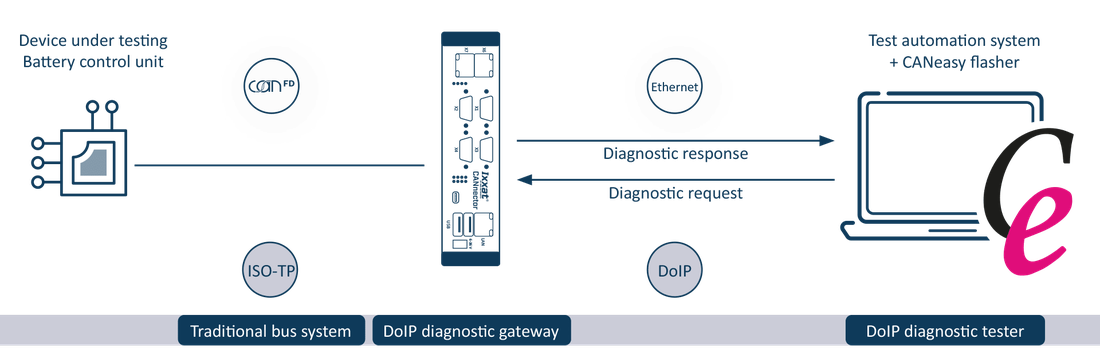
The CANnector is configured as a network component supporting, in addition to DoIP, the ISO-TP transport protocol used on CAN buses. UDS requests sent over DoIP are thus forwarded directly to CAN/CAN FD. Segmentation into CAN FD frames now takes place at the latest possible moment, which reduces latency to a minimum.
2. Standalone configuration with ACT
The CANnector and the other gateways in the automotive product family operate in standalone mode: the configuration is prepared beforehand and then permanently stored in the device. The ACT (Advanced Configuration Tool) engineering software handles this configuration and the connection with CANeasy. Message catalogs — ARXML files, for example — can be imported directly, and the transport layer connections described in them serve as the basis for the configuration.
3. How the diagnostic session runs
The process starts with a request from the tester, containing the diagnostic service and the logical address of the control unit to be flashed. The gateway packs this packet into a CAN/CAN FD message and sends it. On receiving the response from the control unit, the CANnector returns it to the CANeasy tester, for fast and reliable communication.
A hardware and software duo
At the heart of the solution, the CANnector series is not limited to the diagnostic gateway function: besides DoIP and ISO-TP, it provides residual bus simulation, data logging and EtherCAT connectivity on a single platform. It works together with the CANeasy test software, which simplifies configuration and imports ODX and PDX flash containers.
The result
The combination of hardware and software reduced flash times by 20% compared with the previous solution. The specified cycle times are met, and the integrator's competitiveness on its market is preserved.