Test bed connection in automotive production: EtherCAT to CAN FD gateway
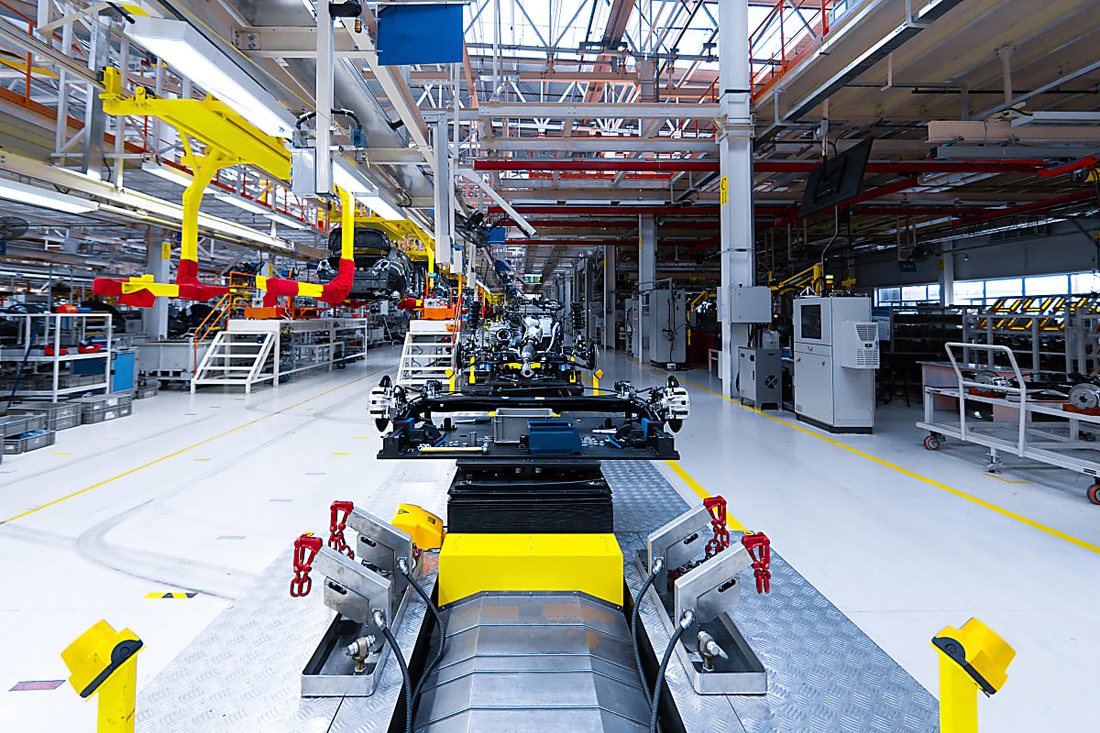
Electric motors, electric axles and transmissions
One single line for very different devices under test
Ixxat Mobilizer Pro 820 EtherCAT, ACT
The problem
One of the world's largest manufacturers of electric motors, electric axles and transmissions carries out, on behalf of leading OEMs, the end-of-line tests integrated into its production lines. These tests must cover many applications depending on the part under test: control unit firmware updates, functional tests, all performed precisely, rapidly and fully automatically.
The difficulty lies in the variety: on a single line, several vehicle models and components from different manufacturers must be handled, without prohibitive setup or changeover times. Each model imposes its own procedures and parameters. For a transmission, gear changes and load distribution are recorded; a few minutes later, on the same line, the speed, acceleration and power consumption of an electric axle must be checked. Tests must be completed within a few minutes and, where necessary, run in parallel.
In addition, the customer had until then relied on DPDU to flash control units, which required continuously sending very many small CAN packets to the gateway — a complicated and time-consuming process.
The solution
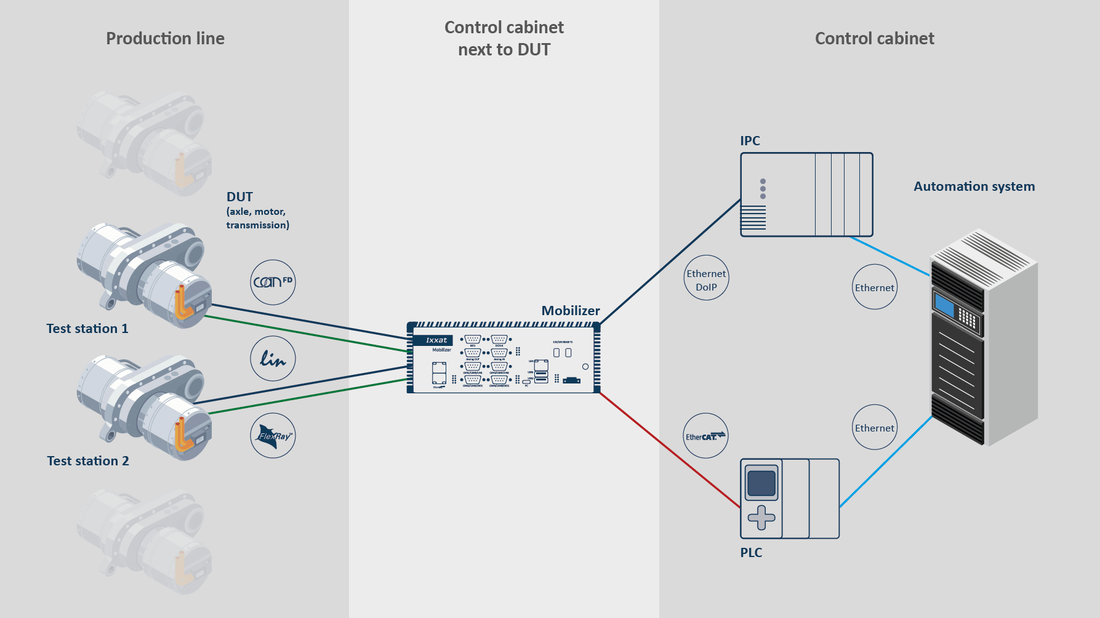
The manufacturer specified EtherCAT as the automation protocol to control the whole system. The Mobilizer provides the connection to this control layer, and the various test scenarios are mapped dynamically onto the gateway: the hardware and the controller connection never change, only the gateway configuration is adapted.
1. Reconfiguration without programming
The ACT engineering software makes it easy to adapt the configuration to each type of device under test, by drag-and-drop and with no programming knowledge. Several configurations can be stored in the Mobilizer, then called up from the automation level and switched quickly — allowing production down to a batch size of one.
2. DoIP for flashing
The Mobilizer supports DoIP: combined with an integrated transport provider, it now transfers large data packets to the gateway efficiently. Together with the quad-core processor and the modern Linux system, this conversion translates into substantial time savings and better use of the available computing resources.
3. Adaptable alive counter and CRC
The parameters and calculation rules used to secure communication differ from one OEM to another and remain strictly confidential. To this end, the Mobilizer provides the alive counter and CRC functions as part of the residual bus simulation, which makes communication with secured control units possible. In ACT, the user selects the corresponding plug-in and assigns it to the configuration: the communication data to be protected is detected automatically and the security applied. Each outgoing protocol data unit secured with SecOC is thus provided with the necessary security data.
The platform
Fitted with all the common in-vehicle networks — CAN FD, Automotive Ethernet (100/1000BASE-T1), LIN, FlexRay, EtherCAT — the Mobilizer series covers data logging, gateway functions, residual bus simulation, firmware flashing and end-of-line tests. With up to eight CAN/CAN FD channels, two LIN channels, FlexRay and EtherCAT interfaces plus digital and analog I/Os, it was developed specifically for automotive test beds. Its 1.8 GHz i.MX 8M Plus quad-core Cortex A53 processor running Linux provides the necessary computing power.
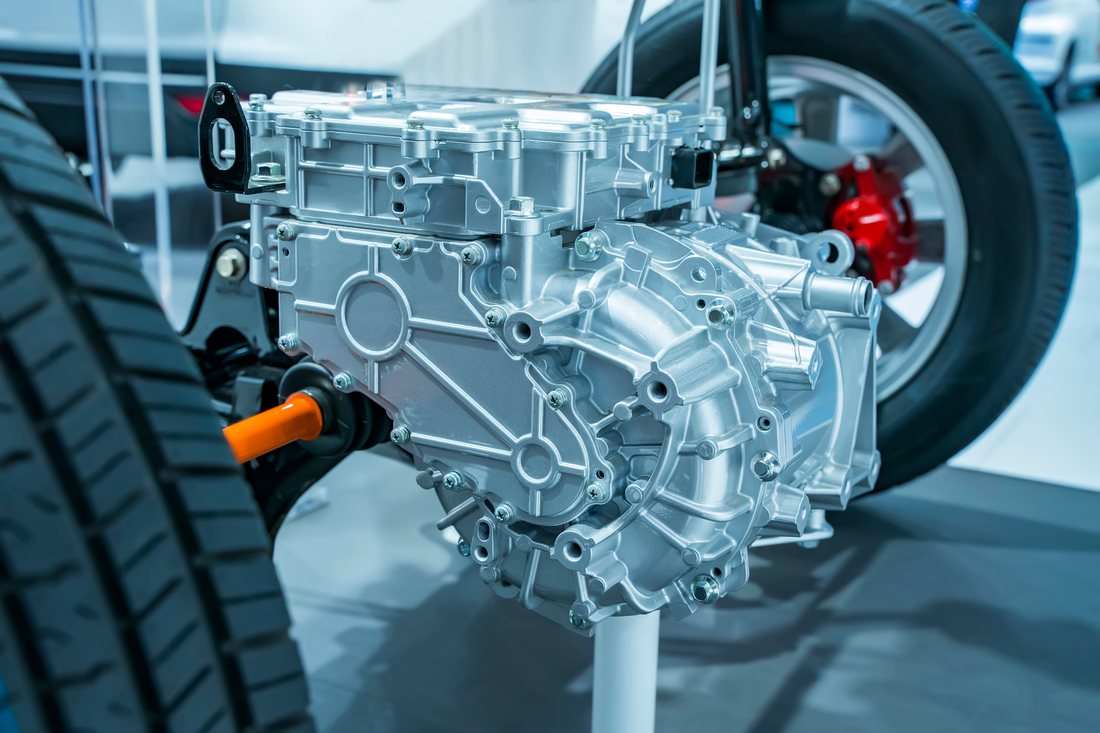
The result
The manufacturer now has a single, stable test chain for very different parts and OEMs. Changeovers are handled by configuration rather than hardware modification, flashing is faster thanks to DoIP, and communication with secured control units remains possible whatever the OEM's encryption generation.