Test lab automation: EtherCAT to CAN FD gateway
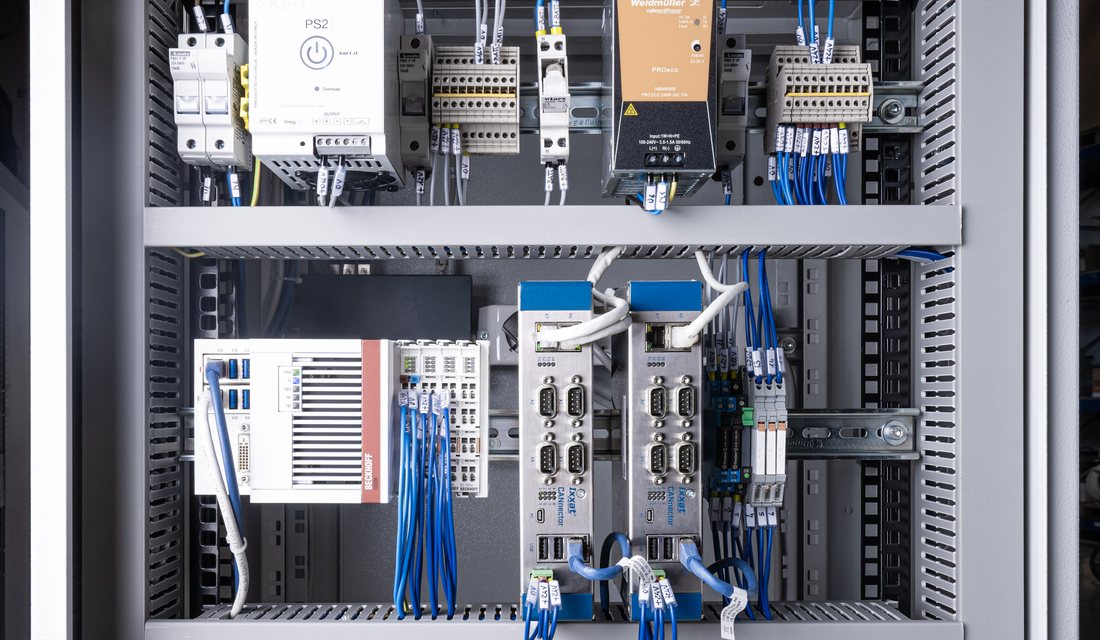
Reinova S.p.A. — Reitech division, Italy
Connecting test bench automation to in-vehicle networks
Ixxat CANnector LE, ACT
The problem
In automotive testing, and even more so in e-mobility, time and system flexibility make the difference. The design validation of electric vehicle components — battery packs, modules, cells, DC/DC converters, electric motors — has to meet the industry's quality standards and safety regulations. To achieve this, communication between the test bench automation and the in-vehicle networks must offer maximum reliability, performance and flexibility.
Reinova, an Italian testing expert based in the “Motor Valley” and a partner of supercar manufacturers, covers several laboratories (EMC, RED) focused on electric mobility, batteries in particular. The variety of devices under test — packs and cells, BMS, inverters, motors — places especially high demands on the interfaces in terms of electromagnetic immunity, uptime and reliability, both in operation and during the application development phase.
“The ACT software allows us to quickly reconfigure the devices in order to vary the signals exchanged between the device under test and the automation system, and to adapt to prototype development.”
The solution
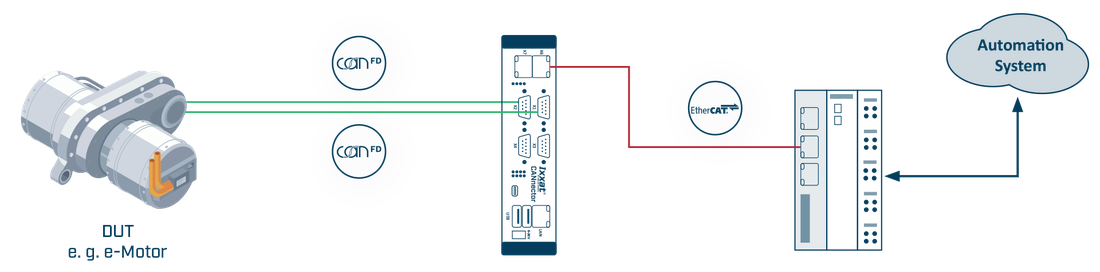
The laboratory relies on the Beckhoff TwinCAT automation system, which controls the whole test bench over EtherCAT, whereas most devices under test communicate over CAN, CAN FD or LIN. To connect these two worlds, the CANnector LE was inserted as a CAN and LIN to EtherCAT gateway.
Depending on customer requests and the parameters to be validated, the setup inside the climate chambers, the configuration, the connectors and the required protocols all vary. The CANnector is not limited to the gateway function: it also runs specific applications, such as converting in-vehicle network signals (DBC, ARXML, etc.) into EtherCAT objects on the fly. As a standalone device, it is connected directly to the device under test and to the EtherCAT master, with no additional PC. Fieldbus length limitations and electromagnetic interference are eliminated, and the surrounding assets are protected from high voltages.
“HMS allows us to extend the functions of a PLC by connecting it to the fieldbuses of the automotive world. With the CANnector, no time-consuming development is needed: simple parameterization is enough, which saves time and money.”
The CANnector platform
Its rugged aluminum housing suits any industrial use. The Linux-based embedded platform covers CAN, CAN FD, LIN and FlexRay and comes with the ACT PC engineering tool. Four D-Sub 9 connectors provide up to eight separate CAN channels, which simplifies the integration of many buses at once. Two USB A ports, one mini-USB and three RJ45 connectors (1 Ethernet, 2 EtherCAT) ensure fast communication between the in-vehicle network, the automation system and the configuration PC.
The result
Reinova has an optimized standalone solution that connects its EtherCAT automation to the in-vehicle networks with no intermediate PC and no specific development. Moving from one device under test to another is a matter of parameterization in ACT, which shortens commissioning and keeps pace with prototype development.