CAN topologies: from the bus topology to the tree topology and beyond
Repeaters, bridges and gateways take the CAN network from the simple line to tree or star structures, in order to cover greater distances, gain bit rate and integrate heterogeneous systems.
The classic bus topology
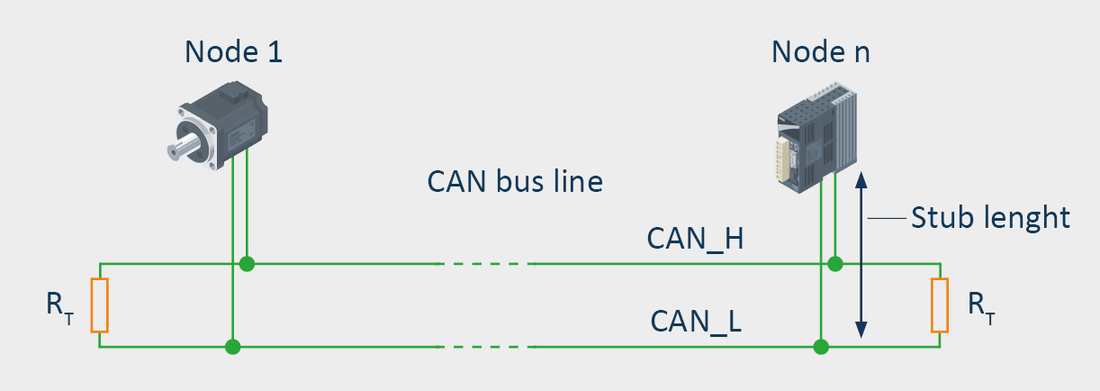
The CAN high-speed standard specifies a simple bus (line) topology, with the CAN-High and CAN-Low signal lines, terminated at both ends with a 120 ohm resistor.
At the maximum bit rate of 1 Mbit/s, the achievable line length is 40 m. Stub lines should be avoided as far as possible: signal reflections degrade the signal quality. They remain tolerable up to 30 cm for the connection of a participant.
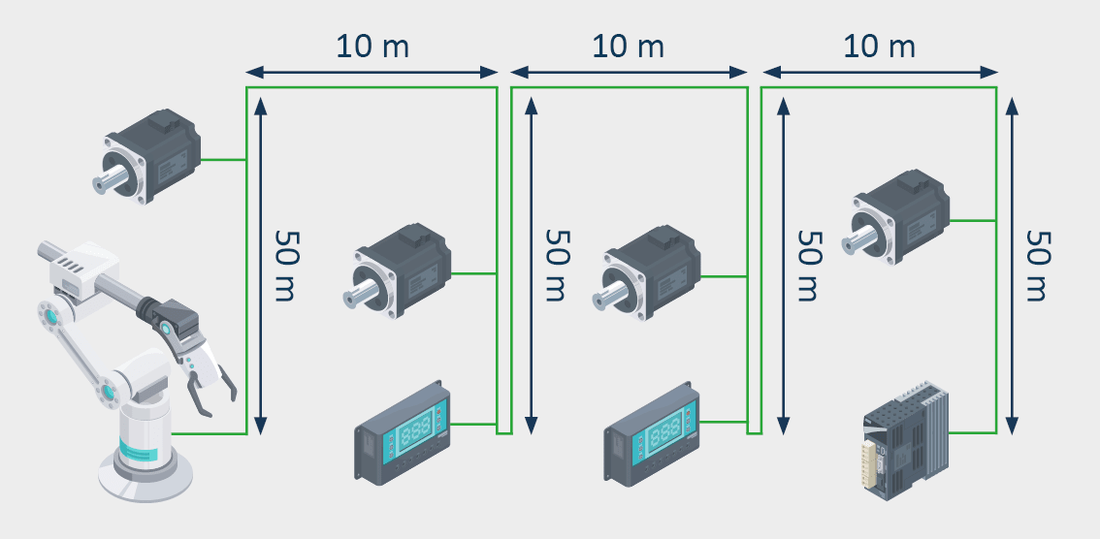
With a bus topology, line lengths quickly become significant depending on the spatial situation. In the example below, looping the bus through all the participants brings its length to 330 metres: on such a system, the maximum bit rate would be 125 kbit/s.
Greater flexibility with the tree and star topologies
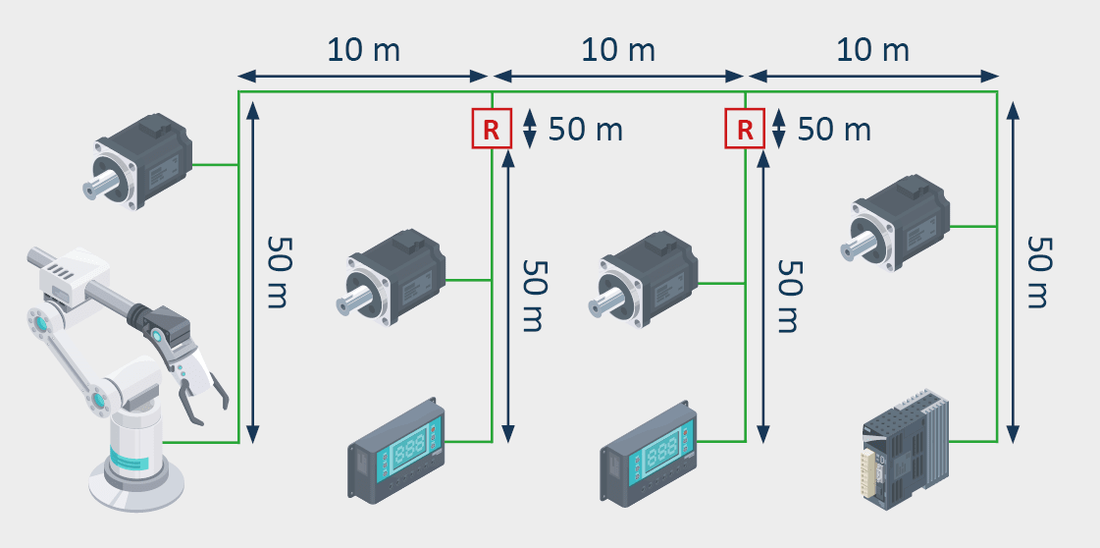
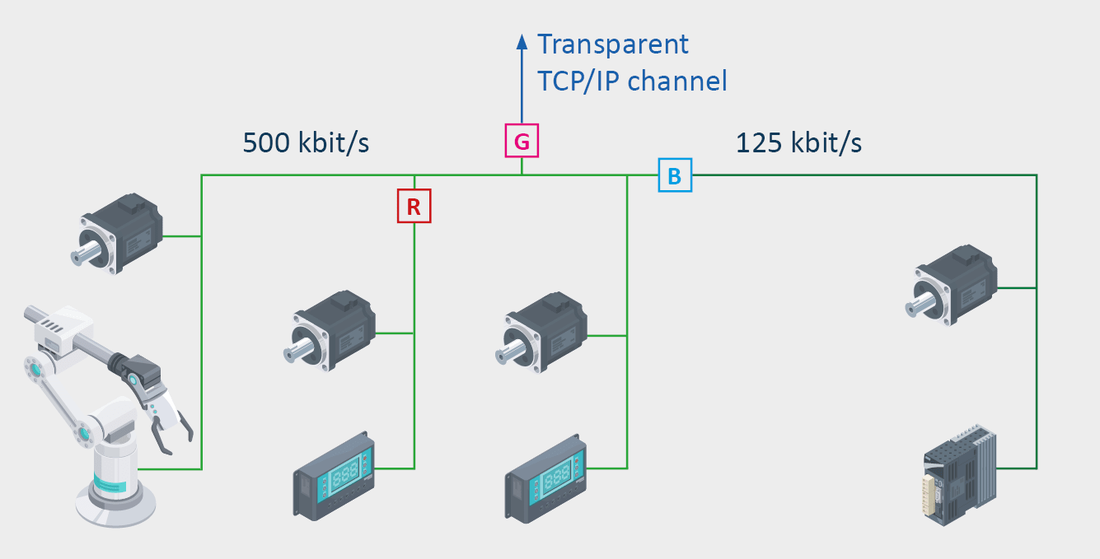
Repeaters make it possible to expand the simple line and to realize tree or star topologies, optimally adapted to the geographic constraints. The repeater provides a physical coupling between two identical buses: it regenerates the signals and transparently passes them on to the other segment. It therefore divides the bus into two physically independent segments; from a signaling viewpoint, it corresponds to a line whose length equates to its delay time.
Thanks to a clever arrangement of the repeaters and the optimal cable routing that results from it, the relevant length of the system — the distance between the two farthest participants — is reduced. In the following example, taking into account the delay introduced by the repeater (equivalent to 50 m of line), the maximum distance between participants falls to 170 m. The system can then operate at up to 250 kbit/s, with better signal quality.
Maximum flexibility: bridges and gateways
CAN bridges have a storage function: they forward messages, or parts of messages, in an independent, time-delayed transmission — the “store-and-forward” principle. They differ from repeaters, which transmit the electrical signals directly.
Integrating filter functions allows for organizational structuring of the network: only the messages of interest to a segment are forwarded to it, which reduces its bus load accordingly. The system range is easily extended, since a bridge divides the CAN network into two systems that are independent of each other as regards signaling.
CAN gateways, for their part, connect networks using different protocols. A gateway application translates the protocol data units into the other communication system, the protocol level at which the translation takes place being identified by the gateway itself. They allow both the coupling of a CAN system with other fieldbuses and the coupling of two CAN systems via a transparent TCP/IP tunnel — enough to connect far-removed CAN systems, or to connect different fieldbuses to a higher-level control system.
In summary
The development from the classic bus topology to tree or star topologies, using repeaters, bridges and gateways, marks a significant evolution in the design of CAN networks. These technologies make it possible to bridge longer distances, to achieve higher data transmission rates and to facilitate the integration of different communication systems — significantly increasing the efficiency, reliability and adaptability of CAN systems.