The OSI model: structuring modern CAN networks

The OSI model divides network communication into seven layers. It facilitates interoperability between systems and serves as the backbone for a clear and efficient network design.
A description standard
The ISO/OSI reference model is a description standard for network protocols. Development started in 1977, with heavy involvement from the International Telecommunication Union (ITU), and it was published as an ISO standard in 1984.
The OSI model structures the complex world of network communication into seven clearly defined layers, each with its own precisely defined tasks. It facilitates communication between different technical systems and promotes the development of new technologies, by making network protocols interchangeable within the same layer. In short, it is the backbone for a structured and efficient network design.
The seven layers
- Physical layer: transmission of raw data bits over physical connections. It deals with hardware components — cables, connectors, physical signals.
- Data link layer: guarantees reliable transmission by organizing data in frames and performing error detection and correction.
- Network layer: responsible for routing data packets across the network. Routers are the typical hardware example.
- Transport layer: segmentation of the data flow and monitoring of the transmission, for reliable delivery.
- Session layer: management and control of sessions between two systems, by defining restart points, for example.
- Presentation layer: conversion of the data into a format understandable by both communication partners, including encryption and compression.
- Application layer: network services offered to end applications; this is the interface to the user.
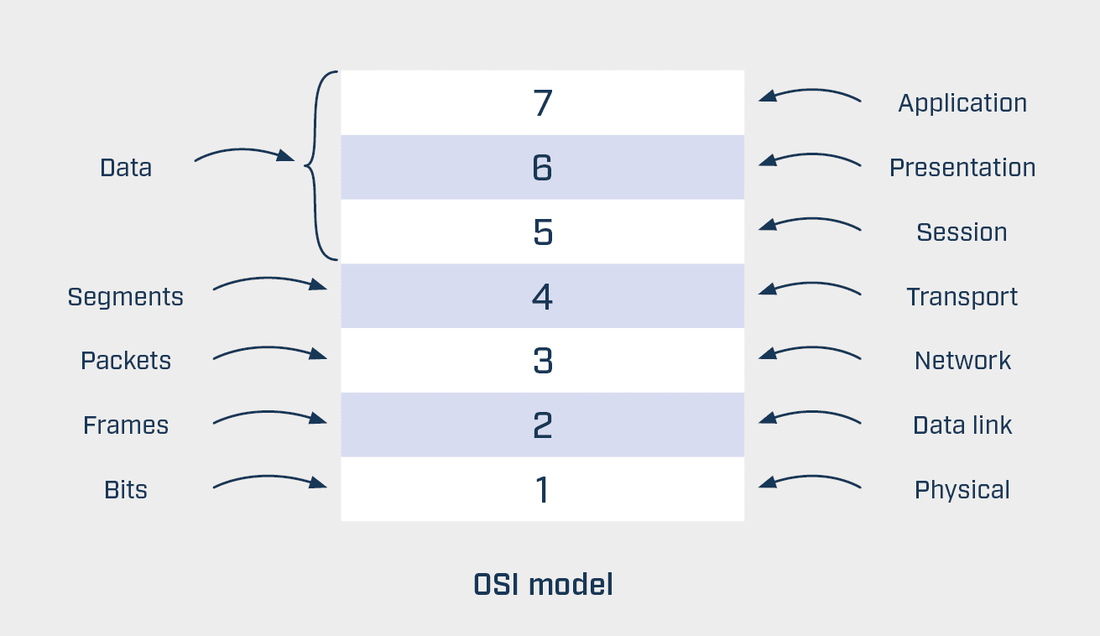
Where does CAN fit in?
The CAN protocol originally specified by Bosch only describes layers 1 and 2 of the OSI model. The wide variety of application areas and possible uses has, however, given rise to a large number of higher-layer protocols, located in the upper layers. One of the most widely used is CANopen.
CANopen is based on CAN: it uses layers 1 and 2 of the CAN standard. On top of that it provides SDO and EMCY as well as PDO bridging services in layer 3. In the transport layer, it enables the transmission of segmented PDOs; layers 6 and 7 provide encoding rules, network management (NMT) and heartbeat services, among others. CAN used with CANopen therefore uses layers 1 to 4, 6 and 7 of the OSI model.
In summary
The OSI model is more than a technical guideline: it is a basic framework that structures and simplifies communication in a digital world. Its concept of layers offers flexibility and clarity. Even though this is a theoretical model, it has practical effects on the development and understanding of network technologies.