Why the line length decreases as the CAN bit rate increases

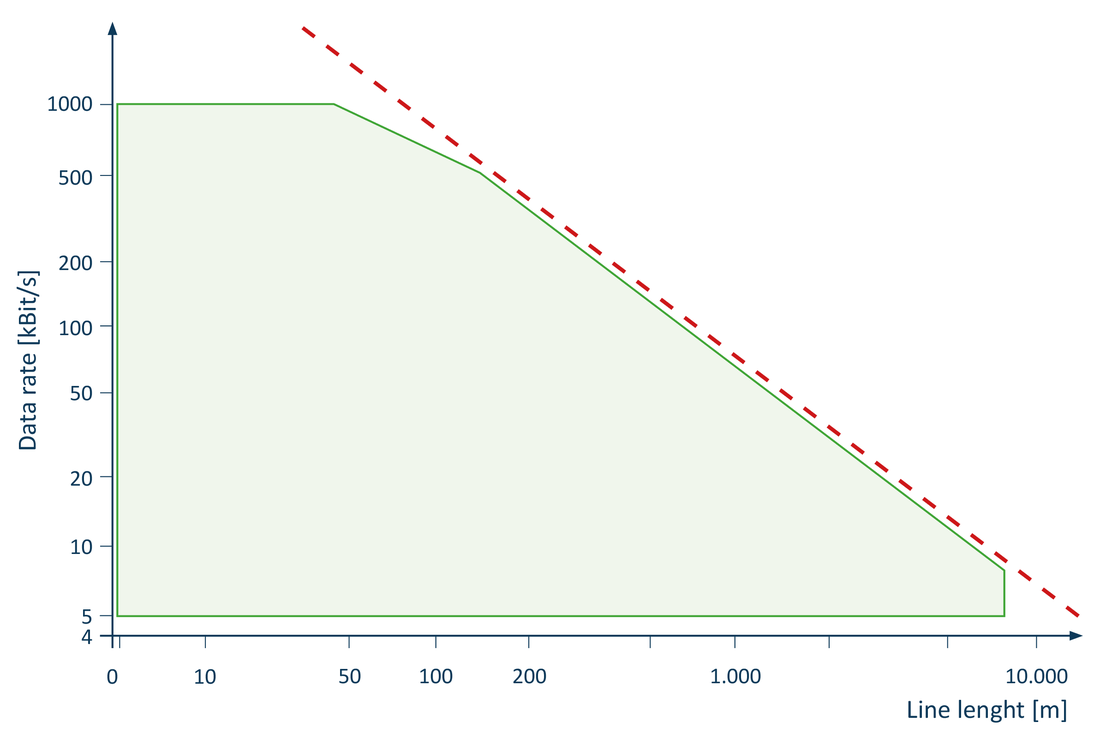
The higher the CAN bit rate, the shorter the permissible line length: arbitration requires a uniform signal level for all participants. Bridges and gateways make it possible to segment the network in order to overcome this limit.
Arbitration sets the limit
Because of the arbitration mechanism used by CAN and CAN FD, the maximum bus length is limited and decreases as the bit rate increases. The participants figure out among themselves who may send; during this phase, the signal level must be uniform for all of them. This is the only way each of them can share the same basis for deciding whether to send or to switch to listening after losing arbitration. See our article on CAN arbitration.
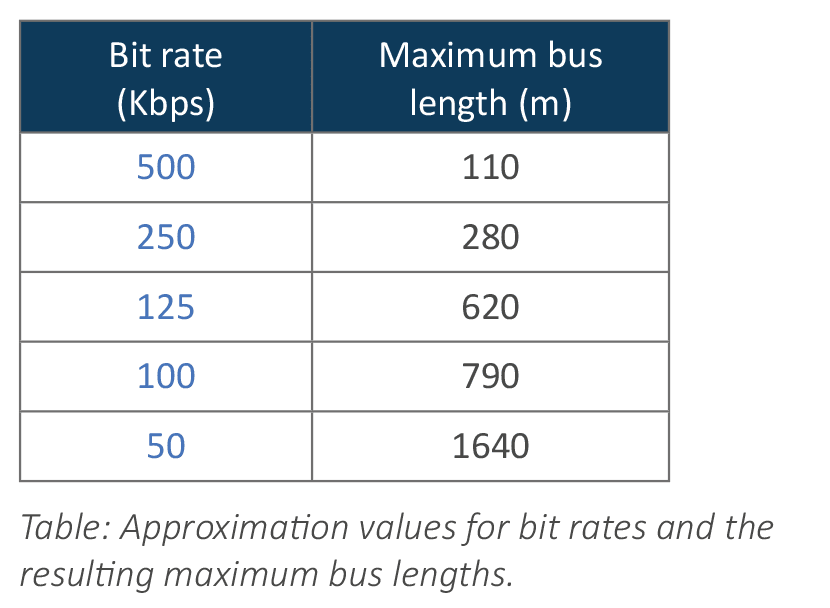
CAN signals propagate on the bus at nearly the speed of light, which may sound very fast. But CAN can be operated at up to 1 Mbit/s, and the delays of the transceivers and protocol modules must also be taken into consideration; since the edges are often not perfectly clean, the whole bit cannot be used for sampling. Taking these constraints into account results in line lengths ranging between 60 and 1,000 metres depending on the bit rate.
A rule of thumb
For line lengths of more than 100 m, the maximum product of the CAN bit rate and the line length can be estimated using the following rule of thumb:

Besides the pure cable length, the use of galvanically isolated bus interfaces also shortens the permissible length: each has to be treated as 10 m of cable.
What to do beyond the maximum length?
If the maximum length is exceeded, the bus must be segmented using CAN bridges or gateways. Repeaters are not suitable: they transmit the signal directly, so the segments they separate have to be counted as part of the main bus for signaling purposes. A repeater with galvanic decoupling also reduces the bus length by 30 metres.
In summary
Higher CAN bit rates lead to shorter permissible line lengths, due to the requirement for a uniform signal level during arbitration. Segmenting the network using CAN bridges or gateways makes it possible to overcome this limitation.