Bit rate and baud rate: what is the difference?
The bit rate measures the amount of data transmitted per second, the baud rate the number of signal changes. The two notions are often — wrongly — confused.
Two distinct figures
- Bit rate: a measure of the transmission speed, expressed in bits per second (bit/s). It specifies how many bits of data are transmitted over a medium in one second, and it is directly proportional to the amount of information transmitted.
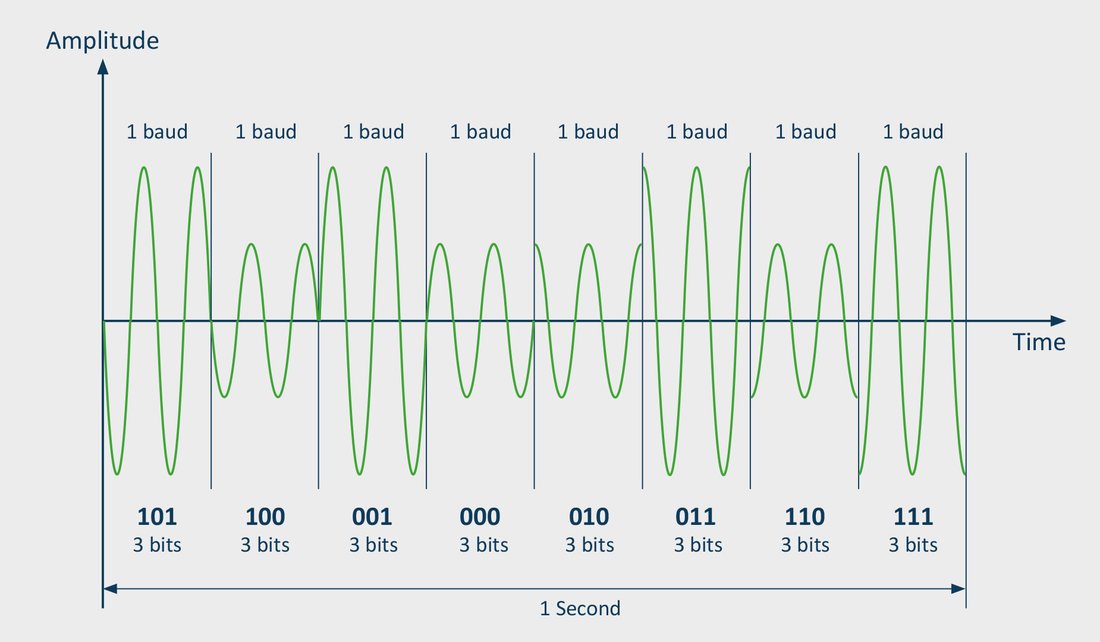
- Baud rate: the number of signal events, or symbol changes, per second. A symbol can carry more than one bit of information. It is measured in bauds (Bd).
The key difference therefore lies in the way information is transmitted: the bit rate quantifies the amount of data, the baud rate the number of state changes of the medium.
In serial digital transmission — as is the case for CAN and the other fieldbus systems — only one bit is transmitted per symbol change (1/0). On these systems, the bit rate is therefore equal to the baud rate.
The gap introduced by modulation
Modulation methods are key technologies in data communication and telecommunication for transmitting information over a medium — cable, air or fiber optics. They modify a carrier signal so that it can carry data. There are different types, each with its own characteristics and application areas.
The relationship between bit rate and baud rate depends on the modulation method used. With simple modulation, such as BPSK (binary phase-shift keying), one baud corresponds to one bit: the two figures are the same. With more complex methods such as QAM (quadrature amplitude modulation), several bits can be coded in one symbol: with 16-QAM, four bits are transmitted per symbol, so the bit rate is four times the baud rate.
Two practical examples
- Traditional modems: a 56K modem, used on older telephone networks, employed complex modulation techniques to achieve a high bit rate over a limited baud rate.
- Modern wireless communication: 4G LTE systems use higher orders of QAM to transmit more data over the same spectrum — the bit rate there is much higher than the baud rate.
In summary
Bit rate and baud rate are two important figures in data communication. They may sound complicated, but at their core they help us understand how fast data is being transmitted and how efficiently a system works. For anyone working in data communication, mastering these concepts is essential to optimizing networks.