Industrial Ethernet: an overview of the most common standards
EtherCAT, PROFINET, EtherNet/IP, Modbus TCP, POWERLINK: each has its strengths and its favoured region. An overview.
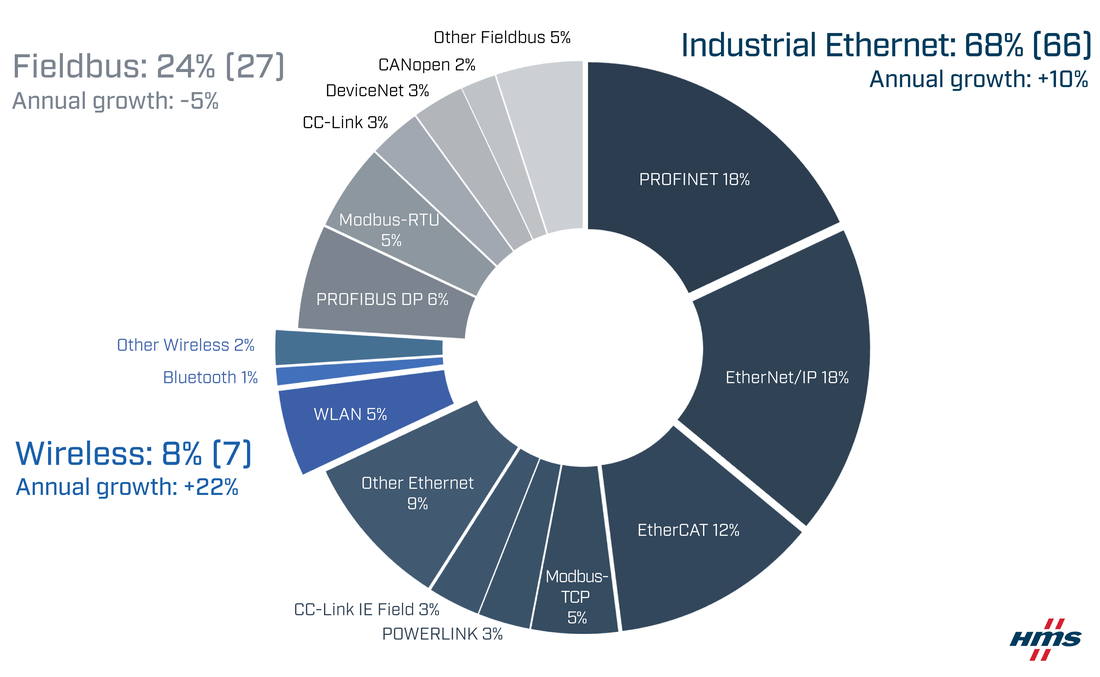
Industrial Ethernet has developed rapidly in recent years and now plays a crucial role in automation and control technology. When choosing, technical differences are not the only factor: the target region for the products also matters. PROFINET is widespread in Europe, while EtherNet/IP is preferred in North America. Selecting a standard that is already established locally makes integration easier; the availability of hardware components and technical support varies by region. Finally, the costs for hardware, licenses and support differ from one standard to another: a cost-benefit analysis is required, taking the technical requirements into consideration.
EtherCAT
- Developer company: Beckhoff Automation
- Typical applications: high-speed machine control, robotics, automotive production
- Characteristics: extremely fast cycle times (down to microseconds) and precise synchronization; particularly well suited to demanding and time-dependent applications; deterministic behavior; high data transmission rates
- Distribution: strong presence in Europe, Asia and North America
PROFINET
- Developer company: Siemens
- Typical applications: process automation, production, building automation
- Characteristics: real-time capability and high data transmission rates; uses standard Ethernet networks; supports deterministic and non-deterministic communication; high level of flexibility
- Distribution: particularly widespread in Europe, especially in Germany, and increasingly in Asia and North America
EtherNet/IP
- Developer company: Rockwell Automation
- Typical applications: system automation, packaging machines, energy monitoring
- Characteristics: supports real-time and non-real-time communication; high data transmission rates; uses standard Ethernet networks; based on the Common Industrial Protocol (CIP)
- Distribution: particularly widespread in North America, also used in Asia and Europe
Modbus TCP
- Developer company: Schneider Electric
- Typical applications: building automation, HVAC, water treatment
- Characteristics: uses standard Ethernet networks; simple implementation; real-time and non-real-time communication; lower data rates compared with other Industrial Ethernet systems
- Distribution: global, without specific regional concentration
POWERLINK
- Developer company: B&R
- Typical applications: machine tools, robotics, CNC
- Characteristics: real-time capabilities similar to those of EtherCAT, with precise time control for critical applications; deterministic transmission; support of redundancies; robust
- Distribution: mainly in Europe and Asia
In summary
The world of Industrial Ethernet standards offers a wide range of options for meeting automation requirements. EtherCAT stands out with the speed of its communication, PROFINET with its flexibility, Modbus TCP with its cost. How widespread they are depends on various factors: the presence of certain equipment manufacturers in the region, local industrial history, sector requirements and the support of industry consortia.