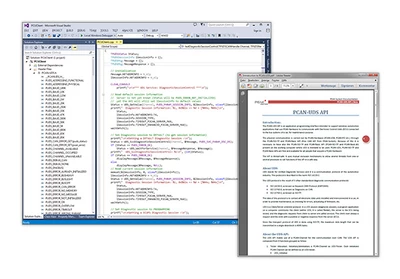

UDS (ISO 14229-1) or Unified Diagnostic Services defines communication with control units. The Windows software tests the controller through various services. The process runs on a client-server model, where the program acts as the client (also called the tester). UDS relies on the ISO-TP standard, allowing the transmission of up to 4 GByte of data.
Beyond the exchange of maintenance information, firmware transfers are also possible.
The PCAN-UDS API implements the Standard's functionality through 8 functions, divided into categories: Tester Allocation, Configuration, Information, Utilities, Services, and Communication.
Features
- Implementation of the UDS protocol (ISO 14229-1) for communication with control units
- Windows® DLL for developing applications for the Windows® 11 (x64/ARM64) and 10 (x86/x64) platforms
- API supporting multitasking
- Physical communication via the CAN or CAN FD bus through a CAN interface from the PCAN range
- Uses the PCAN-Basic API to access the CAN/CAN FD hardware
- Uses the PCAN-ISO-TP API (ISO 15765-2:2016) to transfer packets of up to 4 GByte of data
System requirements
- Windows® 11 (x64/ARM64), 10 (x64)
- For CAN bus connection: a PEAK-System PC CAN interface
- PCAN-Basic API
- PCAN-ISO-TP API
Scope of delivery
- DLLs d'interface (x86/x64/ARM64)
- Examples and header files for all common programming languages
- Documentation in PDF format
| Protocol | UDS (ISO 14229-1) - Unified Diagnostic Services |
|---|---|
| Transport | ISO-TP (ISO 15765-2:2016) |
| Max packet size | 4 GByte |
| Number of API functions | 8 |
| Function categories | ['Tester Allocation', 'Configuration', 'Information', 'Utilities', 'Services', 'Communication'] |
| Model | Client-Server (Tester-ECU) |
| Dependencies | ['PCAN-Basic API', 'PCAN-ISO-TP API'] |